
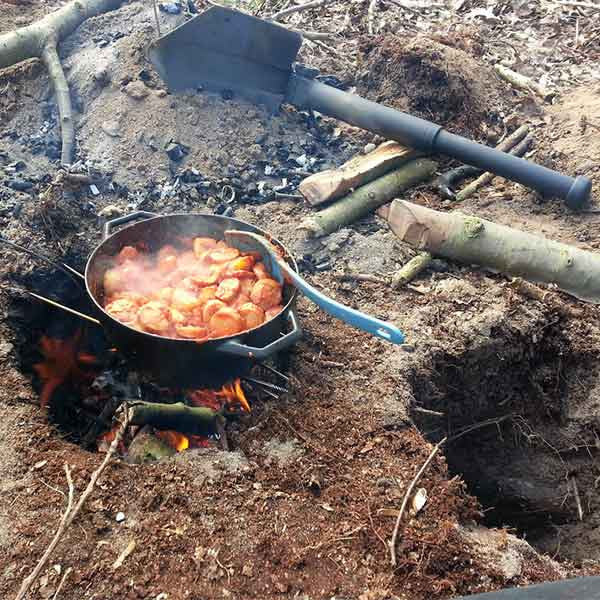
One of the best campfires you can make in nature is a Dakota Fire Hole – but why is that?
First, I’ll explain what it is and briefly touch on the characteristics associated with this type of fire. A Dakota Fire Hole is a fire underground in a hole with an air channel to another hole. The fire type is named by the U.S. Marine Corps and is primarily used as a tactical fire. Once you’ve tried this fire type a few times, you’ll realize it’s important to fire it correctly to minimize smoke. When you succeed, it’s a pure pleasure, and the Dakota Fire Hole is my clear favorite when it comes to fires for cooking! See the detailed explanation further down.
Note: By >> clicking here << you can get direct notification next time there are great guides on the blog.

Here is a list of situations where the Dakota Fire Hole is really good:
In rain and wind, it can be difficult to find sufficiently dry wood for larger fires. Furthermore, you risk the fire going out either because of the wind or rain. You can easily keep a Dakota going if you just have enough twigs and small sticks. Large pieces of wood don’t help at all... in fact, they are just a disadvantage. Remember, of course, not to set up the Dakota in a place where rainwater easily runs down and puts out the fire. That goes without saying.
READ ALSO: Make your own waterproof fire starters for campfires
You want to make a fire for cooking but don’t want a large fire. You don’t need to construct a pot-hang as I have drawn it; you can easily just use fresh green branches as a “grate” for your pot/pan. Make sure to have enough green sticks ready for replacement. Along the way, the green sticks will dry out and burn through. If you have space in your backpack, you can also bring an actual grate or some stainless steel masonry ties to lay out as a grate – I do that sometimes. Last but not least, you can of course also construct a tripod. Find three branches that are half your height and thinner than your wrist. If you don’t have cord, you can tie them together with anything from long grass, vines, thin flexible branches, or roots. Only your imagination sets the limit.

You are in a place where you don’t want to attract attention and you don’t want the fire to be visible at night or the smoke during the day (as there is with a normal fire). Since you have dug your fire down, there are no visible flames and the smoke almost disappears because you burn off the smoke gases due to the increased temperature that naturally occurs when using a reflector.
The technical features and advantages of the Dakota Fire Hole
The principle behind it – Everyone knows a wood stove and most know roughly how it works. You light a fire in the stove, open the air vent in front, and the smoke rises up through the chimney – that’s exactly what happens in a Dakota. Fire is heat and heat rises... when that happens, a suction is created around the fire as it tries to draw in fresh oxygen. The chimney is the hole you have dug, but the hole also functions as the stove itself. No matter what kind of shielding you make around a fire, it will act as a reflector that throws the heat with the fire back toward what is burning. When that happens, the temperature of the flame rises and the smoke that is automatically produced when burning wood contains a number of gases that are also flammable. The gases only burn at a sufficiently high temperature, and when that happens, very little smoke is produced.

Choice of wood – Most fires burn best when you use pieces of wood about a hand’s width and a forearm’s length, but with a Dakota Fire Hole, it’s wiser to avoid large pieces. Aim for sticks no thicker than your thumb and preferably smaller. The fire is stronger and the temperature is higher, but most importantly, there is a correct and sufficient supply of oxygen. If you put large pieces of wood in a Dakota, it’s like putting a whole bag of frozen vegetables in boiling water... after a few seconds, the water stops boiling. In this case, the fire goes out because you both displace the air and the fire. Make sure you have enough sticks to keep the fire going. A Dakota burns quickly and efficiently, and once you realize you’re out of fuel, it’s too late... If you are near spruce, you can advantageously use the lower dead branches. They burn wonderfully because they are bone dry and full of resin, which also burns very well.
Leave No Trace – In Danish, “afterlad ingen spor.” It’s so important that we respect nature and leave it nice when we have been in and used it. Remember, we do not inherit nature from our ancestors... we borrow it from our grandchildren’s grandchildren. When you are done making a fire, it’s easy to cover it with the soil you dug up. That way, you don’t leave any ugly burnt things behind. If you have bio waste, that is ONLY food scraps, you can bury it together with the fire remains.
Choice of “grave site” – Okay, it’s not as dramatic as it sounds, but you do have to dig. The easiest is to dig in sandy soil or forest floor. The disadvantage of sandy soil is that it easily collapses when the soil dries out due to the heat from the fire.
WARNING! – Avoid places with many stones, especially down in the fire hole. Stones that have been dug down contain a lot of moisture, and when the moisture in the stones is exposed to heat, it expands. At best, the stone just cracks down in the hole; at worst, it explodes in your face with a bang. I have experienced many small stones exploding one after another and giving me scratches on my face. One burning shard of stone (about 700-800 degrees) in your eye and the damage is done!
FIRE HAZARD with old peat bogs – It’s not always completely safe to dig your fire pit down. If you are near peat underground, you risk starting a larger fire UNDER the ground. Just read this article from DR
Legislation – Wherever you make a fire, even if it’s in your own garden, there are rules and laws that must be respected. It is always your responsibility in the end...
Ps. Would you like to get direct notification next time there’s something new on the blog?
All you have to do is click here, and a sign-up box will appear :) In addition, you will also get a discount code that gives you 100 kroner off your first order over 699 kroner. There are many benefits to the newsletter!