
Bushcraft - What is it?
Bushcraft is something we hear more and more about. However, it can be confusing to understand exactly what bushcraft is about, as the word is used in many different contexts. This article will give you an insight into what bushcraft is and what this English term covers. Furthermore, the article will briefly touch on the history of bushcraft, how the term has developed in our society over time, and emphasize which skills and abilities a person should possess to master the art of bushcraft fully.
The word bushcraft
The word “bushcraft” originally comes from the English language. It is two words combined and semantically translated to Danish means “brush”/“wilderness” and “craft.” When you first hear the word “bushcraft” and know English, you quickly think that bushcraft refers to the art of making crafts from elements found in the “brush” or generally in the “wilderness.” However, the meaning of bushcraft covers much more than just this kind of craft.
In fact, the term “bushcraft” increasingly refers to an entire set of skills that together give a person the ability to live in and off nature. It is also not enough just to survive by chance – the person should be able to build a sustainable life without help from modern and unnecessary tools. Bushcraft is about only bringing the essentials and being able to enjoy primitive outdoor life, as well as meeting your needs.
If you master “bushcraft,” it is therefore not just about being able to create crafts from nature's elements, but rather being able to live off the land. You must not only survive but thrive, and it is often a lifelong education, as it requires an immense amount to truly master the art of bushcraft.
The history of bushcraft
The idea behind bushcraft has existed in our world longer than we realize, as it was how we lived before civilization as we know it was invented. However, it can be dated when we began to use this term, when and how it also became popular among us.
One of the first times the term bushcraft was used was in Ernest Favenc's 1888 book: The history of Australian Exploration from 1788 to 1888. The more modern phenomenon of bushcraft, however, began with Richard Harry Graves, who established Australian Jungle Rescue Detachment back during World War II. Afterwards, he taught bushcraft and wrote a book called Australian Bushcraft: A Guide to Survival and Camping. Attention to the concept of bushcraft then increased and gradually became world-renowned. The popularity of bushcraft has risen sharply along with various TV programs, which we here in Denmark know as Alone in the Wilderness.
Bushcraft skills
To master bushcraft, it is not enough just to recognize edible plants and be able to build a shelter. You must master a whole set of skills, as knowledge of a single outdoor activity is not equal to bushcraft. Especially skills in shelter construction, fire building, obtaining food and water, and the ability to navigate without GPS are often seen as qualities a true bushcraft enthusiast must possess.
Shelter
To truly master bushcraft, it is not enough just to build a shelter that can give you shelter from the wind and weather for a short time. A true bushcraft shelter can withstand all kinds of weather, and it should be able to provide you with shelter for a long time to come. You should also be able to locate the best place for your shelter and at the same time, be able to predict and be prepared for how the weather can change and what your shelter might need in that context. Joshua Enyart mentions in his 2021 book, Surviving the Wild: Essential Bushcraft and First Aid Skills for Surviving the Great Outdoors, the 5 W’s. These 5 W’s help bushcrafters remember which elements are important to prioritize when building shelters.
The 5 W’s:
- Wood = The possibility of obtaining wood both to build the shelter and for maintaining the fire etc.
- Water = The area's ability to supply the person with drinking water both now and in the future
- Weather = The weather should influence the shelter, its construction, and placement
- Widowmakers = The area should be examined and cleared of dead trees (widowmakers), which can suddenly fall on you and your camp
- Willies = Investigate which insects etc. inhabit the area. This should possibly influence the shelter's construction depending on where in the world you want to build
A shelter can look very different, and there is not one single type that is necessarily best suited for bushcraft, as it depends on the terrain the person is in. Richard Harry Graves, who wrote the book Australian Bushcraft: A Guide to Survival and Camping, describes in detail how you can make both hasty, semi-permanent and permanent shelters, which the constructions later became known as. The 1888 book on modern bushcraft, as we know it today, is one of the earliest instances where shelter-building was described.
Fire
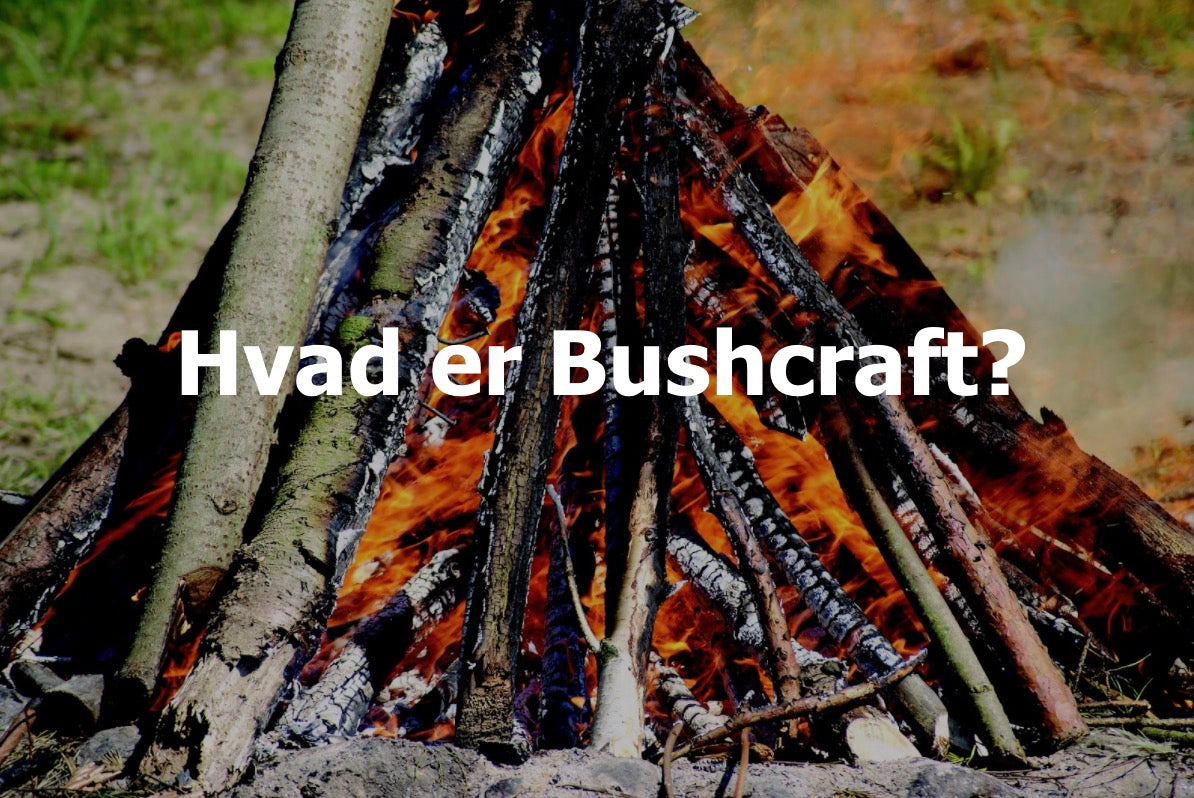
Pyramid fire
The fire is one of the most important skills to master fully in bushcraft. Without fire, you cannot get warm, cook food, or boil water. It is not enough just to know how to split wood and start a fire—you should also be able to keep the fire going and possibly know how to maintain a fire inside your shelter without getting smoke poisoning or burning your shelter down. A true bushcraft enthusiast also knows which materials are best suited to quickly start a fire, regardless of the terrain they are in.
A bushcraft expert should definitely know the classic pyramid fire, called in English Teepee Fire. This is the most basic way to build a fire. Likewise, this method is used to ignite the fire itself for many other fire constructions due to its simplicity.
The durable pagoda fire, called in English Log Cabin Fire, is a more stable fire. This kind of construction makes the fire ideal for prolonged use, as it does not easily go out and is also simple to maintain.
Food and water
Bushcraft is about enjoying the primitive lifestyle, which is impossible without an excellent source of both water and food. A bushcrafter also knows how to prepare food so it is free from any parasites and how infected meat looks. Furthermore, a bushcraft expert knows how long water must be boiled to be clean, how it tastes if it contains bacteria, and how to filter water naturally, if necessary.
There are countless traps that a bushcraft enthusiast should know and be able to use in the camp area, including T-bar snare trap, as it is called in English. This is reportedly one of the most effective traps when set in action. Additionally, Dave Canterbury mentions the well-known Deadfall trap in his book Bushcraft 101: A Field Guide to the Arts of Wilderness Survival from 2014. This trap is also called Paiute Deadfall after the Paiute Indians, who used it frequently. A true bushcraft expert should know animal tracks and understand which trails and similar paths the animals use, so these traps are effective and yield optimal results.
Navigation
A true bushcrafter knows that you cannot always rely on the GPS. If the signal is down, or the person is in an area where the signal simply does not reach, it is necessary to be able to navigate in an area based on older methods. Here, the bushcrafter must truly draw inspiration from the time before GPS and should therefore know both map and compass.
In the book Bushcraft 101: A Field Guide to the Arts of Wilderness Survival, written by Dave Canterbury, are 5 navigation methods described that every Woodsman should be familiar with. In the 2014 book, Dave Canterbury emphasizes the importance of not underestimating the ability to navigate with map and compass. These 5 navigation methods have become well known in the bushcraft community, as they can save any bushcraft expert from getting lost.
These 5 navigation methods, specified by American Dave Canterbury, are called:
Handrails is about being able to move in the terrain and find your way back to camp using only the elements marked on the map. For example, you follow a river to reach another area spotted on the map. Hence, the river becomes the so-called handrail in this scenario. Even if you explore areas around the river, it is essential that you keep being able to see the river in the distance. Likewise, you should have backstops, and these are once again decided solely based on which elements are marked on the map. A backstop can, for example, be a wetland, a cross river, or similar, and if you reach these, you know that you have gone too far and must turn back. Dave Canterbury's accounts of navigation methods continue, and there is plenty of knowledge to gain from the 2014 book, especially when it comes to navigating with map and compass.
There is no doubt that you do not become a true bushcrafter overnight, but there is certainly enough literature, courses, and training available for the interested. Mastering the art of bushcraft is truly a lifelong education, and it takes both time and patience to practice the various skills. Furthermore, it is also about developing a natural sense and feeling for how certain problems and situations should be handled in the best way and how to prepare for possible future ones.
“Not only is it important to understand all aspects of map and compass, but you must also develop a sense of direction and travel by paying close attention to where you have been and where you are going.”
- Dave Canterbury, Bushcraft 101: A Field Guide to the Arts of Wilderness Survival, 2014