
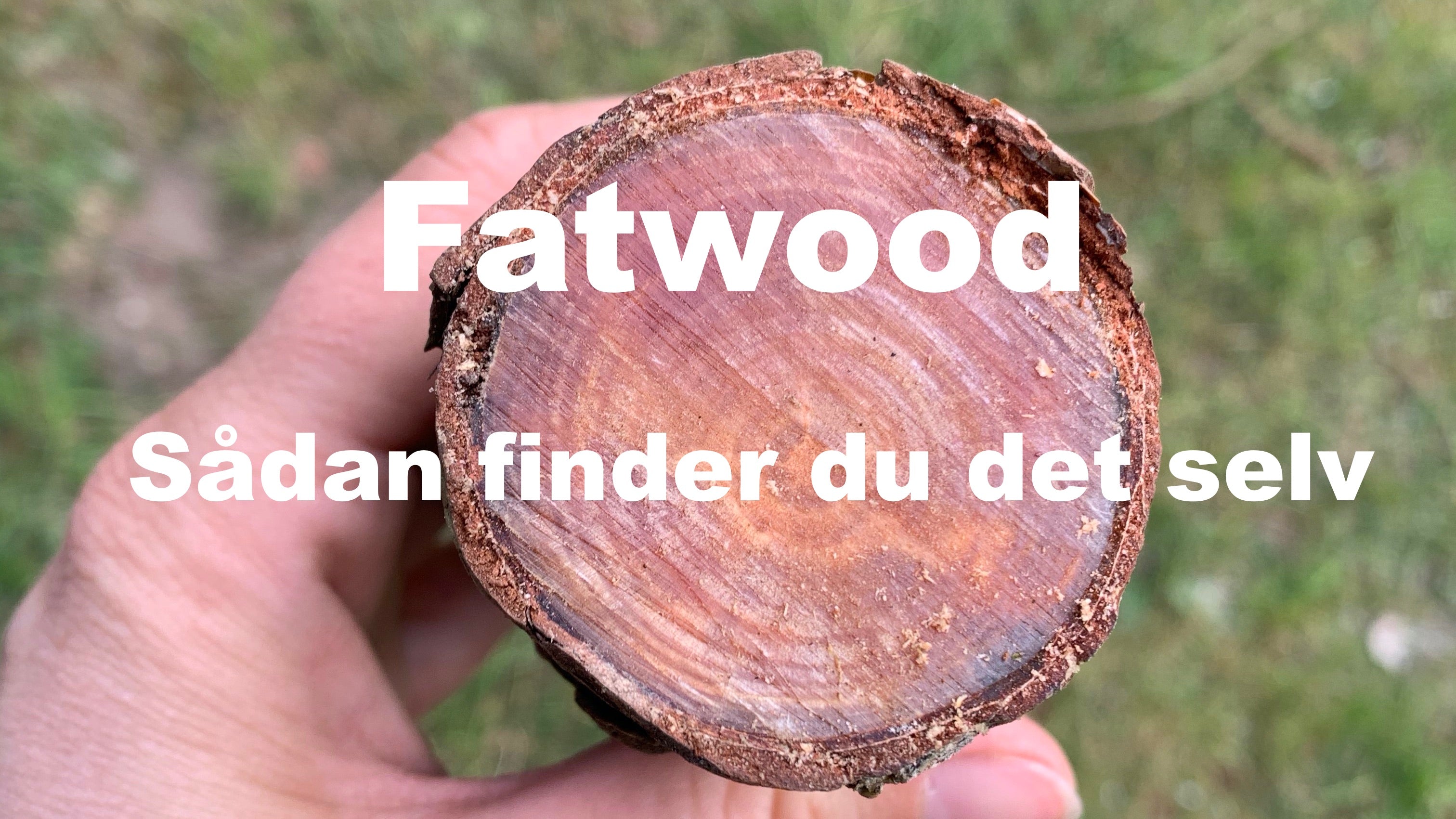
What is fatwood?
Fatwood is resin-saturated pine wood.
We outdoor enthusiasts love it because it makes it incredibly easy to start a fire with, for example, a firesteel, it’s a natural material, and of course because we appreciate nature and that we can make use of its resources.
And hey – it’s super easy to find fatwood in Denmark, just keep reading here!
Where does it come from, and where can I find it?
The tree produces resin to protect itself against fungal attacks, diseases, and damage.
As long as the resin is inside the wood, it is fluid; it only becomes thick like we often know it when it comes into contact with air.
The tree sends resin to vulnerable areas in the wood to protect itself.
You therefore often find large amounts of it in dead branches, stumps, and roots of dead trees.
Resin contains vegetable turpentine, which is why fatwood is so good for starting fires.

Why is fatwood so good?
Fatwood has the advantage that fire catches extremely well on it, even in wet weather.
As mentioned, it is wood saturated with resin, and resin contains vegetable turpentine, which means you can get it to burn just with sparks from your firesteel. This makes it easy to start a fire under your campfire, even in wet weather.
You can find firesteel in all sizes here
How do I harvest fatwood?
It's actually quite easy to harvest your own fatwood once you know what to look for. You will come across it in virtually all Danish pine forests.
First and foremost, it is resin-rich trees where you find your fatwood, that is, pine trees.
Unless you are lucky enough to find an entire dead tree, you can easily find fatwood by looking for dead branches.
I look at the base of the trunk, where I often find branches that have broken off or died, and in these 'stumps' there is plenty of resin, and there you have your fatwood.
You can recognize fatwood by its color and smell.
Your fatwood will appear reddish, slightly glossy, and smell of turpentine.

Branches: Saw or chop the branch off right at the trunk, without damaging the rest of the tree.
You typically won't find fatwood throughout the entire branch, and the concentration will be highest in the part closest to the trunk.
You can easily see which part is fatwood and which part is regular wood. The part that is fatwood will be reddish in color and more glossy. You can simply tell that the wood is saturated with resin.

Stumps: Sometimes you’re lucky enough to find a whole stump from a dead pine tree, and here there’s often plenty of fatwood to harvest. Grab your axe or saw, and then just stock up for yourself and your friends.
Whether it’s branches or stumps, there typically won’t be fatwood throughout the entire piece.
Roots: This is actually where you find the highest concentration of fatwood, but it’s also the hardest part to reach.
If you find a dead tree and feel up to it (and have permission), you can start with your field spade and dig out the roots, giving you access to some fantastic fatwood.


Once you’ve harvested your piece of fatwood, it’s time to get the axe going.
Remove the bark and split the piece into smaller parts.
There is often not fatwood throughout the whole piece, and you can easily see the difference.
It’s not necessary, but I usually chop or carve away the parts that aren’t fatwood, so I just have a nice fatwood stick left, ready for when I need to start a fire.
I usually drill a small hole in one end of my piece and thread a cord through it, so it can hang together with my firesteel.
A little goes a long way
You use your fatwood when you need to start a fire.
Start by scraping a little fatwood off with your knife or axe.
When you have a small pile the size of a large nut, you have plenty.
You should gather everything else you need for your fire beforehand.
That means it’s good to have some dry twigs, leaves, etc., that the fire can easily catch, so you can get your fire going well.
Fatwood burns really well, but with the small amount you need, it’s important to have something else ready that the fire can catch on.
With a piece of fatwood 10 - 15 cm long, you have enough for many fire starts!
So when you find fatwood in the forest, which I’m sure you will, just harvest what you need, so the next person can enjoy the same pleasure you just had.
The trees constantly produce supplies for us, so as long as we take care of our nature and let things take their course, there will be more than enough for all of us.
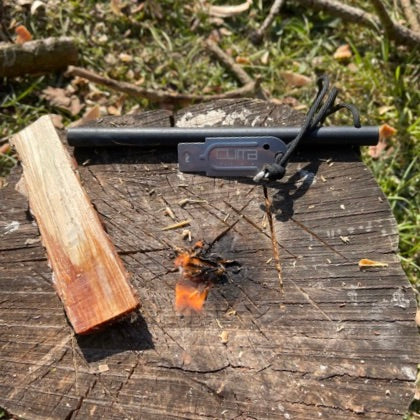 In this picture, you can clearly see that fatwood is not in the entire piece, and how little it takes for the fire to catch.
Have a great time harvesting your own fatwood, I’m sure you will succeed with it 🌲
Many kind regards
Christence.
christence@survivalstore.dk
Do you have more great tips and tricks?
So please do write to me, we would really love to hear from you 👍🏻
You can also watch our video about harvesting fatwood right here 😊