
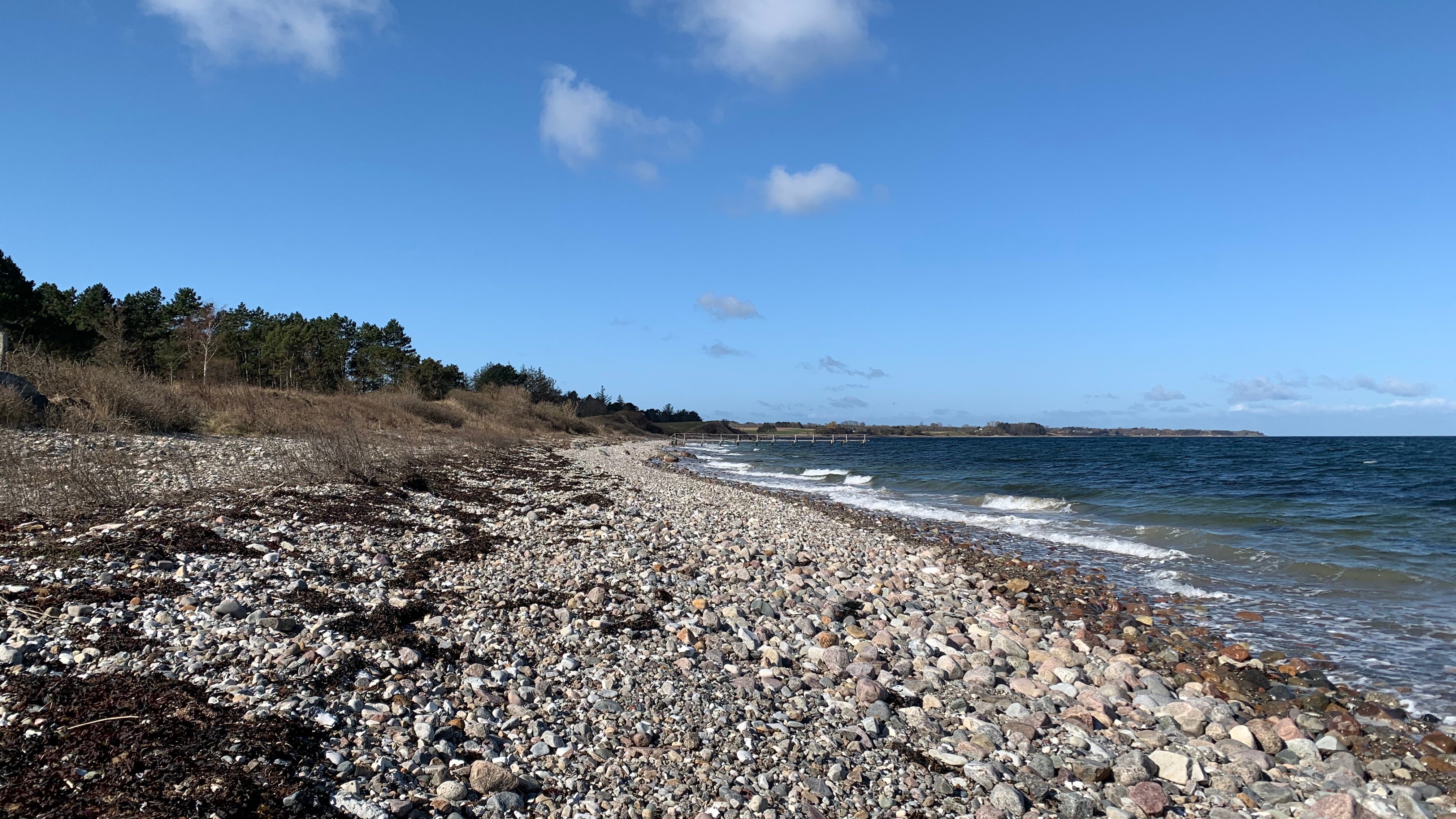
The year's first beach gathering trip.
Here in April, I went on the year's first gathering trip at the beach.
It is still early spring, and the weather changes from day to day, but the plants push forward with indomitable will, and there is already plenty to find, ready to eat.
Here I will present some sure winners that are easy for you to find already here in April.
Sea kale

Once you have spotted the first one, they are quite easy to recognize.
They break through the ground with their small knotted purple shoots and will over the next few months grow into large strong cabbage plants with strong gray-green soft leaves and white flower heads.
In old days, the plant was called 'Asparagus herb'.
Fishermen bleached the stems with seaweed and sand, so they grew long and pale, as we know from asparagus.
The leaves have a strong cabbage flavor, and in my opinion, only the tender shoots are really tasty, or if you are lucky enough to find a plant under a large pile of seaweed, so it is bleached.
Later in the season, they will have large beautiful flower heads that you can use like broccoli or sprinkle the flowers over your food.
Finally, it will produce large crowns with round seed heads (you can usually still see them the following year, unless a strong storm has taken them first). When the seed heads are fresh and green, it is said they can be enjoyed like peas, just with a bit more bite, though I have not tried this myself.
The Food Administration recommends that you only consume it in limited amounts (about 3 x 30 grams), but no acute poisoning cases have been reported.


Sea purslane

Sea purslane is the ancestor of the beets we know today, but here it is the small leaves we are after.
They taste fantastic, I love it! Sweet, salty, and bitter, all in a wonderful combination. At this time, it has strong, small leaves and is easy to recognize.
When the sea purslane flowers, it becomes particularly bitter for a period, but towards autumn you can still gather it successfully, when the bitterness has lessened again.
You can use the sea purslane leaves as you would use spinach. It is suitable for steaming, stewing in, for example, cream, sautéing a bit with garlic, or enjoying raw in a salad.
Tiny sea purslane shoots

Sea purslane is one of the beach plants you can often easily gather in large quantities, as it is quite widespread.
It often grows in old washed-up seaweed, where it can get nutrients from.
Early in the year, like here in April, the shoots are still so tender that it is best used as a garnish on, for example, an egg sandwich, a piece of steamed fish, or as part of a salad. But soon it will stand with its tall beautiful stems and later small greenish flowers.
It is easy to use in your kitchen. It tastes like spinach with a delicious salty touch, and you can use it the same way you would normally use spinach, but it also works well in a pesto.
Toothless Corn Salad

Toothless Corn Salad is usually one of the plants you can forage in abundant amounts on the beach. It overwinters, which means you can start gently picking it early in the year.
You probably already know the taste from lamb’s lettuce, which you can buy in most supermarkets; toothless corn salad is its wild cousin, and you can use it the same way you would use lamb’s lettuce.
It is almost always the case with wild plants that you get a more complex flavor; soil, weather, sky, and sea leave their best mark, giving everything an extra dimension, and it’s just wonderful to eat fresh food you have gathered yourself.
More Toothless Corn Salad

Important to remember when you forage wild plants
Only gather what you need; if there are only a few plants of a species, leave them so more can grow next year.
Double-check the plants you forage until you are completely sure of the species.
Plants and herbs are full of power, but not all of them are good for us to eat.
I recommend that you either use an app or rely on some good books to gain knowledge, information, and inspiration. It’s wonderful to get out into nature and forage herbs and get fresh air, but it’s also great to spend an hour or two with a good book, filling yourself with inspiration and knowledge.
Books I can recommend for those who want to get started or want to learn even more.
Eat Beach Herbs
A perfect book for you who want to take a trip to the beach and forage wild plants. Thorough descriptions of 30 plants and how you can use them.
A really good buy for the price!
The Lord’s Kitchen Garden
The Lord’s Kitchen Garden is one of the books that truly holds a special place in my heart.
Besides being an excellent all-around foraging book, it is so warm and well-written that you can only feel happy reading it.
I have given them as gifts to several of my closest friends, and every time I have received very positive feedback; it really touches the heart.
Edible Wild Plants
A handy little book you can easily take with you, guiding you safely through the most common plants and herbs you will encounter, as well as a few of the more special ones.
While you're out there and have your basket, also remember to pick up the things that DO NOT belong in our nature, and dispose of them properly 😊
