Ranger Beads / Pace Counter for Hiking and Navigation - Everything You Need to Know!
|
|
Time to read 6 min
|
|
Time to read 6 min
Ranger Beads or Pace Beads, as they are also called, are a pace counter, a counting tool that is very useful to have when hiking. When you are hiking, your Ranger Beads help you, in short, keep track of the distance covered.
Here you get a complete guide on how to easily make your own set of Ranger Beads, how to use them, and what the advantage is.
What is this? … it looks like something belonging to a religious person.
In the colorful version… maybe part of some toy?
In its simplicity, it is a counting tool used to keep track of how far you have walked in the terrain when hiking.
Ranger Beads can be made in many ways, and they can count exactly what you need to count.
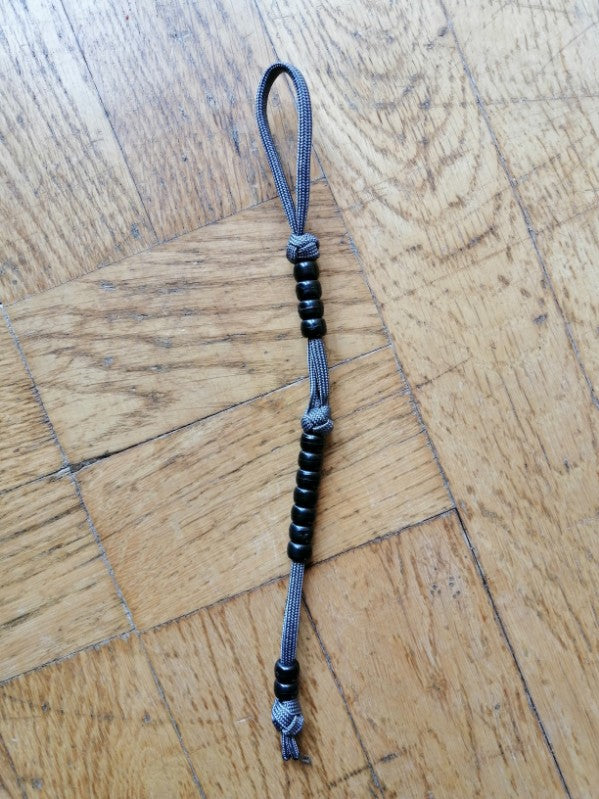
If we look at the classic “Ranger Beads” from the military, it is a piece of string with a loop at the top.
The loop allows the chain to be attached to something, like your clothes or your bag.
Now four beads come on the chain, then a space and some kind of knot.
After this knot, there are 9 beads and then a space, finally ending with another knot.
Pace beads / Ranger Beads can be used alone but work best in combination with a compass. The compass shows you the direction, and the Ranger Beads chain helps you keep track of how far you have gone.
Why not just use a GPS, a watch, or your phone?
Of course… but Ranger Beads are the old way of doing it.
Ranger Beads work even when wet, there is no technology that can break, they are cheap, and above all, they work without power.
The chain should be made so that the beads run a little tight on the string. It doesn’t work if the beads can slide down the string by themselves, as this quickly causes confusion in your counting.
First, you need to find out how many steps you take over 100 meters. (Your test terrain should preferably be flat).
You need a 100 meter measured distance.
Place a clear marker on the ground at the start and end of the 100 meters!
Now you need to walk the 100 meters.
Every time you put one foot on the ground, you need to count!
Over one hundred meters, you will probably have somewhere between 50 - 65 footfalls.
Just walk exactly as you usually do. You don’t need to walk fast or lengthen your steps!
Walk the distance several times and note your results.
If you want, feel free to walk several times; it gives a more accurate result.
Now add all your measurements together and divide by the number of times you have walked the distance.
Now you get your pace count - for example, it could be 63.
That means you now know that when you have walked 63 steps with, for example, your left foot, you have walked one hundred meters.
Now here comes the...
When you have walked the 100 meters or 63 steps, you move one bead down to the lower bead row. (The one with the 9 beads)!
Note! Both bead rows are always placed at the top of the chain when you start!
You continue like this every time you have walked 100 meters.
Here we see a Ranger Beads chain where 200 meters have been walked.
As you can see, there are only 9 beads at the bottom of the chain, so to reach 1000 meters, that is one kilometer, you have to count the 10th bead which is not there!
The row of nine beads is now moved back up to the starting point. You can now start over with the nine beads.
Here is a picture showing 1 km + 100 meters walked.
The entire Ranger Beads chain can show you 5 km. After that, you must note each time you pass another 5 km in another way. For example, with another Ranger Beads chain.
The Ranger Beads chain helps you best if your pace number is optimal.
You can further optimize your pace count in several ways.
Of course, there are several factors that can affect your pace count, so there are several things you can advantageously consider. The more optimal your pace number is, the more accurate your distance measurement on the Ranger Beads chain will be.
Walk on uphill or downhill terrain. You can choose to have a pace number to follow when walking uphill.
It is rare that we walk on flat terrain for the entire trip. Therefore, it can be an advantage to take measurements on flat, descending, and ascending terrain.
Remember to take an equal number of measurements on all three types of terrain!
As before, add all the numbers together and divide by the number of measurements. Now you have an average number that takes terrain types into account.
Walk with your gear. Pack a bag that matches the weight of the typical bag/gear you use.
Is it a fully packed hiking backpack, or a small daypack with just a few items?
The weight of your bag especially affects your pace on uphill terrain.
Walk at a fast pace. From time to time, we need to cover a distance quickly.
Maybe you need to reach a campsite before dark?
Your pace decreases when you walk faster; your steps simply become longer.
Maybe your pace goes from 63 down to 55 per hundred meters.
This may mean you need to change your pace if you are walking fast!
Optionally take time? You get a better idea of how long it will take to cover a distance.
This realization will make you better at navigating.
You will have a better understanding of whether you have gone too far or gotten off track.
Now you know how long it takes you to cover a kilometer, even with the heavy backpack on your back.
How do I make my own Ranger Beads chain? And what do I need?
It’s easy and requires only a few materials to make your own Ranger Beads chain.
You will need the following for a Ranger Beads chain:
-A wrist-length paracord.
-Thirteen beads.
-A lighter.
-A knife or scissors.
See paracord in various colors and color combinations of high quality, which is a perfect foundation for your Ranger Beads chain, right here!
We base this on the classic Ranger Beads chain from the military, with a loop for attachment.
First, pull out the inner strands of your paracord, all the small inner threads inside your paracord.
Now you are left with a paracord tube.
Now burn the cord at both ends, one end should preferably be slightly pointed. Roll it after heating, without burning yourself!
Find the middle of the cord, fold it to make a loop, tie a knot by folding the cord around itself. Like when you start a bow on a shoelace.
Now you have made the loop, which can be used to attach the Ranger Beads chain to your bag.
Next, place the first 4 beads on the cord.
Note that it is the pointed end of the cord that is last threaded through the bead - this makes it a bit easier.
After the beads are placed, make about the same distance as the beads take up before tying another knot. There must be room for the beads to slide down the cord!
The process continues with the 9 beads being added in the same way.
When the 9 beads are on the cord, there should again be the distance corresponding to the space the beads take up on the cord.
Tie a final knot and your Ranger Beads chain is basically ready to use.
Cut the cords and burn the ends so they don’t fray.
Your Ranger Beads chain is now finished. -A simple, useful, straightforward, and inexpensive tool for your hike.
The Ranger Beads pace counter is simple to make and very useful when you are hiking. Ranger Beads are a versatile tool that can be used for many purposes when you are outdoors. They are inexpensive, easy to use, and can be customized to your individual needs.
Ranger Beads can be varied endlessly and are useful for much more than just measuring distance.
This is another way a Ranger Beads chain can look.