
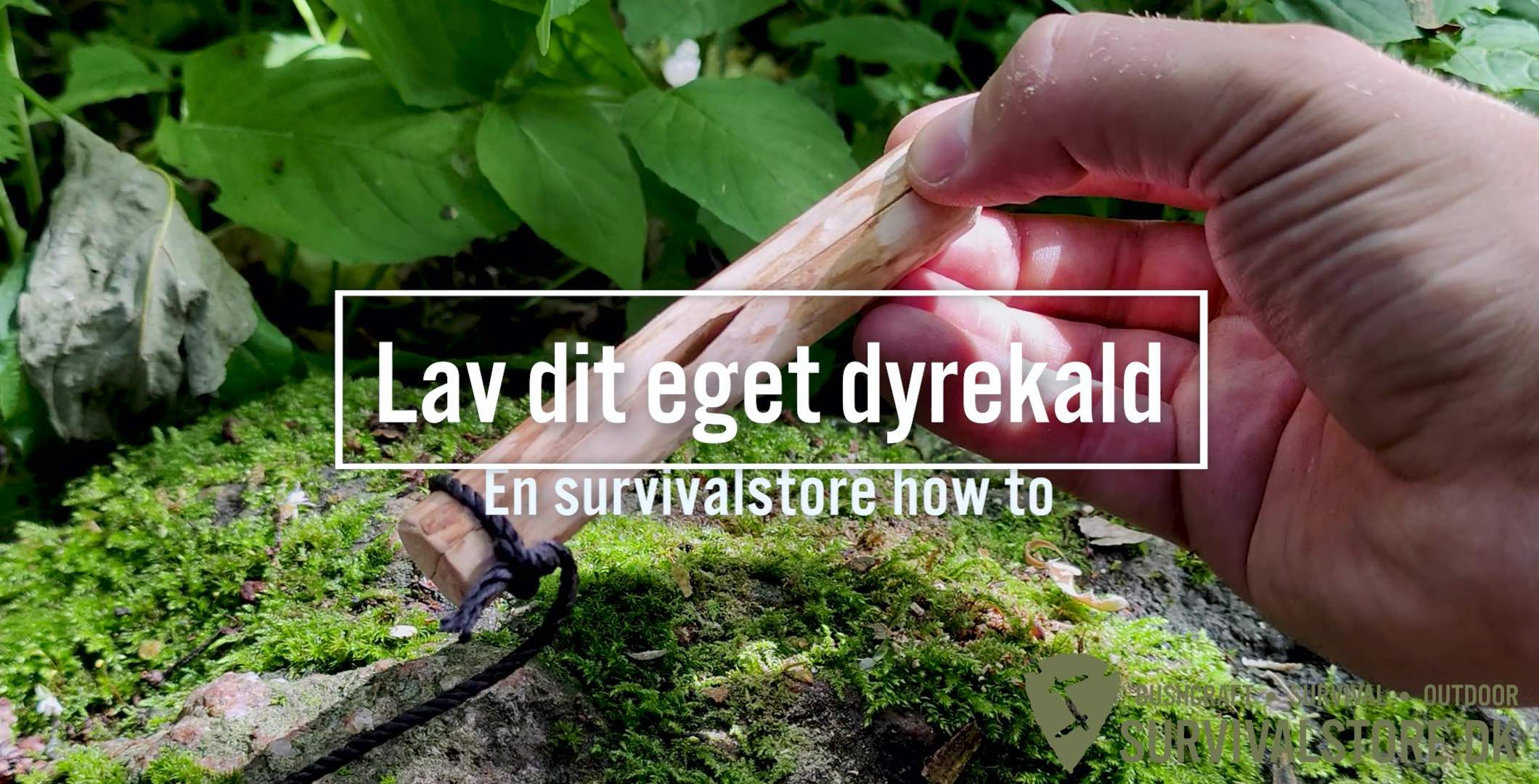
This blog post will focus on much more than just making an animal call.
We will delve into how you best motivate the child or young person to explore nature, so confidence grows, and the close bond to nature can be successfully formed from early childhood.
Read on here and get plenty of ideas for great nature experiences; maybe there is even something you as an adult can benefit from.
On uncertain ground with confidence!
Nature gives children much more than mosquito bites and ticks; it is an extremely effective and comprehensive learning environment where they can test and develop both body and mind. Sensory-wise, there is nothing better for a curious sensory system than coming into contact with soil, insects, leaves, mild scents, dry branches, wet leaves, sticky resin, stinky deer droppings and owl pellets, sharp thorns, soft moss, buzzing mosquitoes, and earth bumblebees.
It is a jumble of education and sensory-motor gymnastics, and everything the children can absorb is turned into useful information for both body and mind.
That said, it is no secret that the forest, for some children and young people, can be a place associated with insecurity. Not necessarily a paralyzing insecurity, but a feeling of unease expressed through caution and a greater need to be close to mom and dad when they are out in nature.
The forest can look overwhelming. The dense and sometimes dark passages of the forest and claustrophobic sensations can be sensory challenging for children to navigate if they are not used to sorting through all the information they are bombarded with.
On top of the physical aspect, there may be demands that do not match their skills and abilities in all the practical work involved in a trip to the forest. If you are going to make a fire, eat packed lunches, set up a tent, or just hike far without purpose or goal, the child can become demotivated, frustrated, and upset if the task does not match their abilities.
So what can you do to give the child or young person a feeling of motivation and confidence that builds on developing skills and security in nature?
Let's start with a practical task, let's make an animal call.
The Flow Theory
No matter what task or play you choose for children, whether in nature or elsewhere, you optimally stimulate the child's development when the child is in a state of FLOW.
Flow is a theory formulated by the Hungarian psychology professor Mihaly Csikszentmihalyi and is based on positive psychology, describing the conditions necessary for a person to be in a state of flow.
You probably know the feeling. You are engaged in a project or activity that completely absorbs your attention and time, to such an extent that when you look at the clock, one or more hours may have passed without you noticing. You were in a state of flow, where the task matched your abilities and where the level of feedback and feeling of success were decisive and sufficiently motivating for you to continue under sustained or increasing challenges.
The flow state is important for the child’s experience of connection in nature and generally in everyday life. The need to experience immediate feedback through the actions they perform motivates and creates meaning in the context the child is in and is essential for development and belief in their own abilities. Confidence!
If the child does not experience a connection and success between action and result, frustration/anxiety naturally arises, and if repeated failures occur where the child’s abilities are insufficient for the demands, the child becomes demotivated and most likely finds something else to do or becomes upset. The child is only in flow when the abilities match the task, which we as adults can help regulate.
On the other hand, if the child’s abilities exceed the demands of the task, the child will not find the task or result stimulating and will therefore become bored. This ultimately will not give courage or desire to repeat similar tasks with the same enthusiasm.
The graph below shows the conditions needed to achieve a state of flow.

The graph is a visualization of when the child achieves a state of flow. The task’s difficulty must not exceed the child’s skills, as this can lead to 'anxiety' and stress. The task must also not be too easy, as this can lead to boredom.
But when you match the task with the skills, the child can achieve flow and experience an increase in difficulty and skills during the task as the child can develop and adapt abilities themselves.
Our advice for achieving flow is to start gently with the demands. It’s better for the child to start off bored until you find the right level, rather than the child immediately facing an overwhelming wall of demands and being confronted with all the things they struggle with.
As you gradually get to know the competencies and comfort level regarding play and work in the forest, it becomes easier to plan and create suitable tasks considering flow.
Let's now take a practical task in nature as a starting point that we can adapt and try to match skills with challenges.
The Call - How to do it.
An animal call in this context is a thumb-sized stick, split in the middle, lightly hollowed out, and with a blade of grass in the center. This simple toy/tool can be used in several ways. It is like a whistle that makes the sound you get when you blow through a blade of grass held between your thumbs. On one hand, it is a task we can work on to go through the steps of what it means to construct such an animal call, meaning we make the animal call to develop skills in carving, sanding, and processing materials in the forest.
It can also be a task where we focus on a shared process, with more help and support, where the flow process comes into play later through play and fun with the animal call.
No matter where the focus lies from the adult’s perspective, it is important that the child experiences flow through the different stages. So if the child needs more support with the practical aspects, where flow can still be achieved through help and delegation of tasks, support where it makes sense and try to achieve greater independence and flow through a related game afterward.
The animal call is definitely a way to initiate possible connections to nature, as a simple homemade animal call can lead to play and learning. The animal call has a comforting aspect because it is a way to contact or attract attention if you get a little separated during an activity or while exploring.
The animal call can be a demanding process, and we recommend it for older children, from 8 years and up.
Step by step
At all stages of constructing the animal call, consider the visual presentation, meaning examples of what to work on and how. Have an animal call ready and be familiar with the process yourself.
A good idea is to demonstrate:
- The finished product made beforehand
- Tools (knife, saw, string)
- Techniques, as you gradually get to them.
Introduce the animal call and what it can do, then get started quickly.
Step 1: Find a stick
The stick should be thumb-thick (adult thumb) and preferably long since you can always cut it down. The process can take as long as needed because the child will explore the area and may decide and change their mind about a stick several times. Set the framework for what should happen and allow space. Stay close for questions and guidance.
The type of wood doesn’t matter, just make sure the stick is not rotten or fresh, so we don’t damage new trees. A fallen, dry stick from a tree will be fine.
Step 2: adjust the stick
Now the stick needs to be sawed, split, and carved.
Assess the child's skills with the tool and support them along the way if needed. It’s better for the child to receive support from an adult than to face failure due to too high demands.
Saw the stick from both ends so it is about 7-10 cm.

Split the stick lengthwise in the middle, using a knife where you stand it upright and tap the knife blade with another stick. This is called batoning.
Now carve a depression on the inside of each half of the stick, so there is a hollow space in the middle when you put the two halves together again. The blade of grass should lie in the hollow space.

If it’s too difficult to carve the hollow space, have a stick prepared with coarse sandpaper so they can sand a depression without struggling to angle the knife correctly.
Carve or saw a small groove all the way around the top of the stick for a string later, so the animal call can be hung in a pocket or on a bag. Avoid making necklaces and bracelets, as it’s never smart to run through a forest with a string around your neck.
Step 3: Find a blade of grass
Find a blade of grass you can insert into the hollow space. Same process here, set the frame with an example and let them explore nature. The blade of grass can be wide and better too long than too short.
Insert the blade of grass and tie the string in the groove.
Step 4: Test the animal call
Now find the right position for the blade of grass, the right angle with your mouth, and how hard to blow. It should produce a high and clear whistling sound. Replace the blade of grass when it gets too wet or breaks. Be patient in this step; it can be challenging to find the right combination of angle, blade of grass, and blowing strength. 
Step 5: Play!
As mentioned, there is a security element in being able to call your friends or family across the forest with an animal call, which is an important aspect if you don’t feel safe in the forest area. But it is also a tool we can use for activities like hide and seek.
Choose an area where the play will take place and then play hide and seek with animal calls. You decide the rules, but use the animal call to signal the person who is seeking. It’s a fun and good way to explore nature while using the animal call in an exciting and different way.
Remember!
It doesn't have to take long to make the animal call. What flow is about is matching challenges with skills and giving the child a feeling of success and an experience of overcoming a challenge. The experience of coherence and meaning is more important than the task taking a long time. Flow also happens in small moments and in the play afterwards.
If children are to be encouraged and motivated to enjoy nature (and everything else for that matter), their motivation and desire must be built on confidence-building successes, based on a sense of security and the knowledge that support is available if they become overwhelmed. Support the child's natural instincts in the forest and give room for imagination.
🎥 We have also made this step-by-step guide as a video - watch it here 👇🏼