
A guide to foraging the first green shoots of spring
Spring begins to quietly emerge in March, and although nature still looks a bit winter-weary, the forest floor and roadside edges already hide delicious, edible plants. If you love outdoor life and bushcraft or just want a taste of the wild nature, now is the time to take your foraging knife and set out on an adventure – there are incredibly many exciting plants and herbs to forage already in early spring.
Here’s a guide to some of the best plants you can forage in March – and how you can use them in your outdoor life.
What does it mean ‘to forage’?
To forage means to gather edible plants, berries, mushrooms, or other natural resources from the wild. It can also include collecting driftwood, stones, seaweed, or other materials that can be used practically. Foraging has been part of human life for millennia and was essential for survival before agriculture developed.
Today, foraging is popular among outdoor enthusiasts, bushcrafters, survivalists, and those who want to eat more naturally and sustainably. Many forage to supplement their diet with fresh, wild ingredients, while others do it for the experience – it can be relaxing, educational, and a fantastic way to spend time in nature.
Examples of foraging:
🍄 Mushroom hunting in the forest during autumn
🌿 Collecting wild herbs such as nettles, wood sorrel, and wild garlic
🍓 Picking berries like blueberries, raspberries, or sea buckthorn
🌊 Gathering seaweed for cooking or fertilizer
🔥 Collecting dry branches and cones for kindling a fire
When you forage, you gain access to free and natural food directly from nature. It’s a sustainable way to gather food while enjoying time outdoors. Foraging also offers the chance to experiment with new ingredients in the kitchen and when cooking over an open fire. Wild herbs, mushrooms, and berries can provide exciting flavors and add unique nuances to your cooking.
Here’s a guide to which wild plants you can forage in March – perfect for outdoor life, bushcraft, and survival:
1. Wild Garlic (Allium ursinum) – the wild counterpart to garlic.
Wild garlic is one of the most popular spring herbs, a true wild delicacy that starts to appear in the forest floor during March.
Where to find it? The forest floor in deciduous woods, especially in moist, shady areas. It thrives in large colonies, often covering the forest floor with its green leaves.
How to identify it? Long, lance-shaped leaves with a strong garlic scent.
How to use it: Wild garlic is perfect in soups, pesto, or as a seasoning for food cooked over a campfire.

Foraging tip:
Use a lunchbox, harvesting bag, or cloth bag to store wild garlic and whatever else you gather on your foraging trip, so they are well protected and stay fresh.
2. Ground elder (Aegopodium podagraria) - weed with flavor and nutrition.
Ground elder is one of the first plants to sprout in early spring. Many see it as an annoying weed in the garden, but it is a fantastic edible plant with a mild taste of parsley and celery, packed with nutrients and vitamins, and can be used in salads, soups, and as a "spinach" substitute.

Where is it found? Gardens, ditch edges, and forest edges.
How do you recognize it? Three-lobed, light green leaves – easy to confuse with other plants, so be sure before you eat it!
How to use it: Use the young shoots in salads, omelets, or as a filling in a wrap when cooking outdoors.
Foraging tip:
🔥 Cooking over a campfire? Use a cast iron pan to make a ground elder omelet on the fire!
3. Nettle (Urtica dioica) - a vitamin bomb from nature.
The tender nettle shoots are full of vitamins and minerals and can be used for tea, soup, stews, or dried for later use.
The nettle plant is covered with small, stinging hairs filled with a mixture of histamine, formic acid, and other irritating substances. When the hairs break on contact, these substances are released and can cause a burning, itching sensation on the skin. Therefore, it is a good idea to wear gloves when harvesting nettle. If you don’t have gloves, you can also grab the nettle leaves by the stem and fold them gently so the hairs don’t sting.
Once blanched or dried, they lose their stinging effect.

Where is it found? Everywhere! Along paths, in gardens, and in open fields.
How do you recognize it? Dark green jagged leaves – and of course the well-known stinging hairs!
How to use it: Perfect for soup, tea, or as a spinach substitute in stews.
4. Dandelion (Taraxacum officinale) - the whole plant is edible.
The first dandelion leaves start to appear in March and are fantastic in salads or as a vegetable filling in dishes. They have a slightly bitter taste reminiscent of arugula and are packed with vitamins and minerals.
Later in the spring, the beautiful yellow flowers appear on long stems.
The entire dandelion plant can be harvested and eaten.

Where is it found? Everywhere - fields, meadows, gardens, and by the roadside.
How do you recognize it? The jagged leaves, the yellow flower, and the distinctive white milky sap.
How to use it: The young leaves are delicious in salads, the roots can be roasted and used as a coffee substitute, and the flowers can be made into syrup.
Foraging tip:
The dandelion has long roots; use a good knife or a field trowel to dig them up.
5. Plantain (Plantago major and Plantago lanceolata) – An overlooked but useful foraging plant.
Plantain is one of the most common wild plants in Denmark, but it is often overlooked as an edible plant. However, it is both nutritious and versatile in cooking and has a long history as a medicinal plant.
There are several species of plantain, but the two most common in Denmark are:
Ribwort plantain (Plantago lanceolata)
- Narrow, lance-shaped leaves with distinct veins.
- Has an upright flower stalk with small brownish flowers.
Common plantain (Plantago major)
- Broader, round leaves with distinct ribs.
- Has a tall flower stalk with small seed heads.


Where is it found? In lawns, fields, and along paths.
How to use it: Plantain can be used both raw and cooked. The young leaves have a mild taste and can be used in salads, wraps, or as a green garnish. The older leaves can be finely chopped and added to soups, stews, or casseroles. The seeds can be dried, ground, and used in bread or as a nutritious addition to oatmeal. Both leaves and seeds can be used for tea, which is said to have a soothing effect on the respiratory system.
Foraging tip: Use plantain leaves as emergency "bandages" if you get a scratch or a nettle burn on your trip. They have a soothing effect when crushed and applied to the skin. Plantain has antibacterial properties and can be used to relieve insect bites and minor wounds.
6. Yarrow (Achillea millefolium) – Nature’s wild herb and medicinal plant.
Yarrow is one of nature’s most versatile plants – it can be used as a spice, tea, and natural medicine. With its spicy scent and flavor, it resembles thyme and sage, making it perfect for both cooking and as a warm drink on a foraging trip. For centuries, yarrow has been used in folk medicine for everything from digestive issues to wound treatment. It contains bitter compounds and essential oils that may have a calming and anti-inflammatory effect.

Where is it found? Meadows, roadsides, fields, grasslands, and forest edges. It loves sunny, dry areas and often grows in large groups.
How do you recognize it? The leaves are feather-shaped, finely divided, and slightly hairy. They have a strong aromatic scent reminiscent of thyme or sage when rubbed between the fingers. With small, white or slightly pink flowers growing in dense clusters.
How to use it: Yarrow is a strong plant, so use it sparingly to avoid an overpowering taste. Dried flowers and leaves can be used for an aromatic herbal tea said to have a calming effect. Fresh or dried leaves can be used in soups, stews, or as a sprinkle on meat and fish dishes. Yarrow is naturally bitter and can be used to make homemade schnapps or bitters, perfect for an outdoor lunch. Make a wild herb butter with chopped yarrow, butter, and salt – perfect for campfire-baked bread or meat.
7. Juniper (Juniperus communis) – The aromatic spice of the forest.
Juniper is one of the few wild spices you can find in Nordic nature. The small, dark blue berries have a distinctive spicy and slightly resinous flavor used in everything from game dishes to gin. But did you know that the berries, needles, and twigs from juniper can all be used in cooking?

Where is it found? Juniper grows in dry areas such as heaths, dunes, forest clearings, and grasslands. It appears both as a low shrub and a small tree. The ripe, dark blue juniper berries can be foraged from late summer to winter (September-March). The green, unripe berries can also be used but have a sharper taste.
How do you recognize it? Juniper has stiff, pointed needles. They have a light stripe on the upper side. The berries themselves are small, round, and bluish-black when ripe. Unripe berries are green. Juniper is low-growing and often irregularly shaped with thin, thorny branches. Juniper smells and tastes spicy and slightly bitter – known from gin and game dishes.
How to use it: Juniper adds a deep, aromatic flavor to many dishes. Crushed juniper berries are perfect for marinades and stews, giving a spicy taste to hearty soups and sauces. Homemade gin or schnapps gets an aromatic boost from juniper. You can also use juniper branches to smoke meat or fish for a delicious, spicy aroma!
8. Sweet Violet (Viola odorata) – The fragrant delicacy of the forest floor.
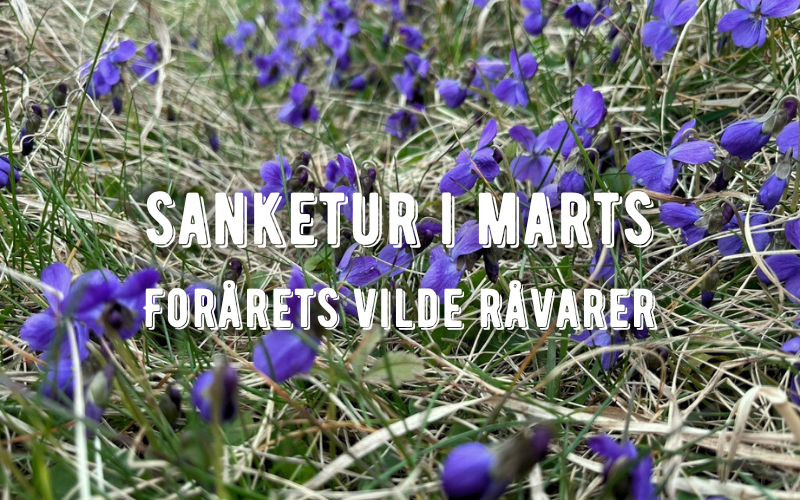
Sweet violet is one of spring’s most beautiful and aromatic wildflowers. The small, violet flowers smell sweet and can be used both in cooking and natural medicine. The flowers, leaves, and roots are edible and have a mild flavor that pairs perfectly with desserts, salads, and tea.

Where is it found? Sweet violet grows in deciduous forests, gardens, parks, and along forest paths. It thrives best in moist, nutrient-rich soil in partial shade.
How do you recognize it? Small, violet flowers with five petals and a distinctive, sweet scent. The leaves are heart-shaped, light green, and slightly curled along the edges. The plant is low-growing and carpet-forming, often in small colonies close to the ground. Sweet, floral scent and mild, slightly spicy taste.
How to use it: Harvested leaves and flowers can be used in salads. The delicate flowers can be used as decoration on cakes, for herbal tea, or you can make homemade violet syrup by boiling the flowers with lemon and sugar, and use the syrup for, among other things, cocktails, soft drinks, or pancakes.
9. Sea kale (Beta vulgaris ssp. maritima) – Wild Nordic spinach.
Sea kale is one of the coast’s hidden delicacies – a wild relative of chard and beetroot. With its juicy, slightly salty leaves, it is a fantastic ingredient in cooking and a great alternative to spinach. It grows wild along the Danish coasts and is rich in vitamins and minerals. The plant is high in vitamin C, iron, and antioxidants. It has traditionally been used to strengthen the immune system and improve digestion.

Where is it found? Sea kale is found along coasts, beach meadows, and salt marshes. It thrives in sandy, salt-affected soil and often grows in small colonies. The young leaves can be harvested from early spring to late autumn. The older leaves are tougher but still edible.
How to recognize it? Wavy-edged, smooth, dark green leaves that look like spinach but are thicker and juicier. A low, rosette-like plant that can grow up to 50 cm tall. Small greenish-purple flowers in spike-shaped clusters in summer. Lightly salty, mild, and nutty flavor – like a mix of spinach and chard.
How to use it: Sea kale is incredibly versatile and can be used both raw and cooked. Use the young leaves raw – they taste fresh with a slightly salty edge and can replace spinach or cabbage in soups, stews, and other hot dishes. Finely chopped sea kale is perfect in, for example, omelets. If you chop the leaves and mix them into bread dough, it gives a salty, herbal flavor. Try steaming sea kale with a bit of butter and garlic in a foil tray – perfect with fish and seafood!
10. Sea kale (Crambe maritima) – The wild delicacy of the coast.
Sea kale is one of the most sought-after wild edible plants along the Danish coasts. With its juicy leaves, crisp shoots, and edible flowers, it is a true gourmet plant that resembles a mix of cabbage and asparagus. It is rich in vitamins and minerals and has been an important food source in the Nordic countries for centuries. The plant is high in vitamin C and has traditionally been used to strengthen the immune system. The bitter compounds in the leaves can also stimulate digestion and help against bloating.

Where is it found? Sea kale thrives on rocky and sandy coasts all over Denmark. It often grows in dunes and coastal meadows, where it tolerates both salt and wind. The tender shoots appear in March-April and are the most delicate. The leaves can be foraged throughout spring and summer, while the flowers and seeds can be harvested later in the season.
How to recognize it? The shoots are small and purple. Gradually, they become large, thick, wavy, and blue-green leaves with a slightly waxy surface. A robust, perennial plant that can grow up to 60 cm tall. Small, white flowers in large umbels that smell mildly of honey (blooms in June-July). The taste resembles mild cabbage with a slight salty hint – the young shoots taste like a mix of cabbage and asparagus.
How to use it: Sea kale can be used in many ways – both raw and cooked. The tender leaves and flowers can be eaten raw and have a mild, nutty flavor. The young shoots resemble asparagus when lightly fried in butter or steamed. Foraged sea kale also works as a tasty vegetable in hot dishes. The thicker leaves and shoots develop a delicious, sweet flavor when cooked over an open fire. Try grilling sea kale shoots with a bit of lemon and butter – simple but wonderfully tasty. Or blanch the young shoots briefly and serve with butter and salt – a Nordic counterpart to white asparagus!
Spring foraging: Tips for a successful foraging trip:
Bring a good guide – Make sure you can correctly identify the plants you forage.
Forage with respect – Only pick what you need, and leave enough for nature, other foragers, and animals.
Choose clean areas – Avoid foraging near busy roads or polluted areas.
Use your senses – smell, taste, and feel the plants you forage to ensure they are edible.
When foraging, it is important to check and be sure you do not mistake plants and end up foraging something that could be poisonous. Therefore, feel free to use an app for plant identification or look it up in a book that can help you. We have several good foraging books, full of inspiration, that can help you get started or continue with foraging.
March is a fantastic time to get out and start the season's first foraging trips. With these edible plants in your bag, you can make delicious, wild meals and get closer to nature.
Remember to follow the rules: In Denmark, you may forage for personal use in public forests and natural areas, but in private forests, you need the owner's permission.
Enjoy your foraging! 🌿
Equipment for your foraging trip:
It doesn't require much equipment and gear to forage, regardless of the season. With a sharp knife and a cloth bag or lunchbox, you can go far. When foraging, it's important that you recognize the plants and herbs you collect, so it can be a wise precaution to have an app available on your phone or a book with you to identify the species you forage.