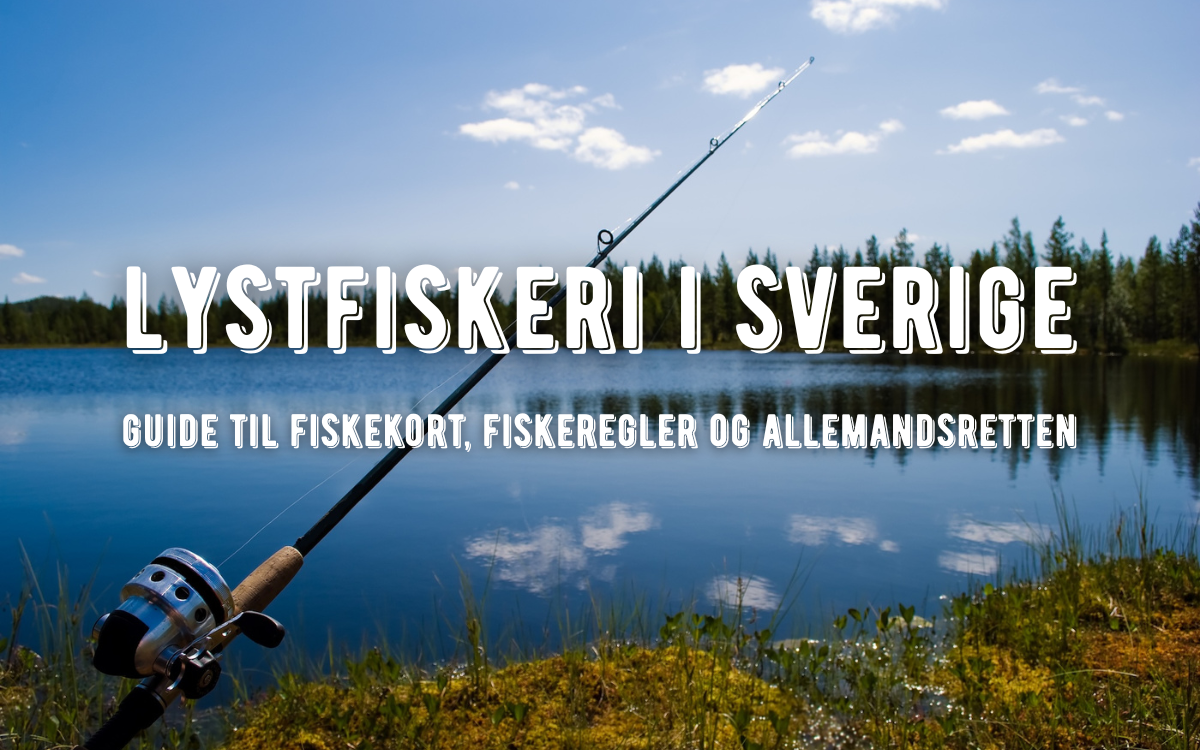
Recreational fishing in Sweden – Nature experiences and world-class fishing
Sweden is a true paradise for recreational anglers. From quiet forest lakes and rushing rivers to open coasts and deep fjords – all over the country there are countless opportunities for recreational fishing, for both beginners and experienced anglers.
Do you dream of catching a sea trout in Skåne, a big pike in Mälaren, or a wild salmon in Norrland's rivers? - In Swedish fishing waters, you will find something for every taste.
Thanks to the right of public access, everyone can move freely in nature, but fishing usually requires a valid fishing permit and knowledge of local rules. There are also special closed seasons and catch limits that must be respected to protect the stocks.
In this blog, you can read about fishing in Sweden, how to find and buy fishing permits, which rules apply to fishing in different types of waters, and which species you typically can catch in Sweden.
In short: everything you need to get started with recreational fishing in Sweden's unique nature.

Here is what we cover - go directly to the topic by clicking the link
Fishing regulations in Sweden
General information about the rules
Sweden has very rich fishing waters – both in the beautiful archipelago, along the coast, and in lakes and rivers in the mountains.
But fishing is regulated to protect fish stocks and nature. The rules can vary from place to place, so it is always important to check local regulations on, for example, iFiske.se or the county administrative board's website (the Swedish county).
Overall, it can be said that recreational fishing in the sea and in the five largest lakes in Sweden (Vänern, Vättern, Hjälmaren, Mälaren, and Storsjön) is free for everyone - other areas require a valid fishing permit. Regardless of where you fish, applicable rules must be followed. This is explained further below.
Fishing in lakes and rivers (freshwater)
In lakes and rivers, fishing rights are usually private or owned by a local fishing association.
Therefore, you must always buy a fishing permit unless you fish in a state area (the five largest lakes mentioned earlier). In a section further down, you can read more about buying fishing permits.
Rules such as minimum size, closed seasons, and maximum number of fish per day vary between waters.
Many fishing permit areas have their own regulations, for example:
“Max 3 trout per day”
“All pike over 80 cm must be released”
Excess catch should be released gently.
Recreational fishing for sale is not allowed.
Fishing by coast and sea (saltwater)
Fishing in sea and coastal areas is free for everyone, thanks to the right of public access.
You may fish with hand tools (rod, jig, line, fly). Get more info on the marine and water authority's website www.havochvatten.se - here you can search for example “fishing in the sea” or “coastal fishing”.
Although fishing is free in these areas, you must still comply with:
Closed seasons (e.g., for cod, salmon, trout),
Minimum sizes set by Havs- och vattenmyndigheten (HaV),
Protected zones, where fishing is prohibited to protect, for example, spawning areas, birdlife, and much more.
Closed seasons -Closed seasons protect fish during spawning periods. They vary by species and area.
Minimum size -Minimum sizes ensure, for example, that fish have time to spawn before being caught, and that a good and healthy stock is maintained.
Catch limits
Penalties and inspections
Violations of the rules or fishing without a valid fishing permit can result in fines and/or confiscation of equipment. The Fisheries Agency and police often conduct inspections.
Right of public access – specifically for fishing
The right of public access (“Allemansrätten”) in Sweden gives everyone the right to move freely in nature – on foot, by bike, canoe, ski, etc. – but it does not automatically grant the right to fish freely.
Here is an overview of what the right of public access specifically means for recreational anglers in Sweden:
What you may – and may not – do as a recreational angler
You are allowed to:
move along lakes, streams, and coasts (as long as you do not disturb or damage nature or privacy),
bathe, rest, and camp briefly on uncultivated land,
fish freely in the sea and along the coasts, because saltwater fishing is free for everyone (with ordinary hand gear such as rod, line, or jig).
You are not allowed to:
fish in freshwater (lakes and streams) without permission or a fishing permit,
fish close to private property (e.g., inside a yard, garden, or near residential houses),
damage nature, fences, animals, or disturb birdlife.
Fishing permits and fishing licenses
For most lakes and streams, the following applies:
you must buy a fishing permit (iFiske.se), issued by the local fishing rights owner (often an association or private landowner),
a very few areas are state-owned and allow free fishing – this includes the large lakes Vänern and Vättern
Basic rule
“Inte störa, inte förstöra”
("Do not disturb, do not destroy")
Respect nature, wildlife, and property rights.
This is the core of the right of public access – and it also applies when you practice recreational fishing.

How to buy a fishing permit in Sweden – step-by-step with iFiske and local businesses
A fishing permit in Sweden is your ticket to fishing in some of Europe's best fishing waters. Although Sweden offers endless lakes, rivers, and streams, fishing rights in freshwater are not free. You need a valid fishing license (in Swedish: fiskekort), which allows you to fish in a specific area. Each area is managed by a local association or fishing rights owner – so rules and prices can vary quite a bit.
Fortunately, it has become much easier to find and buy fishing permits thanks to digital platforms such as iFiske.se, which has gathered thousands of fishing waters in one place.

iFiske can also be downloaded as an app on your smartphone, so you always have it handy.
You can buy a fishing license on the day you plan to fish, so you don’t need to buy it in advance, but be aware that the fishing permit often only becomes valid at least 15 minutes after payment (you can also choose the time – both date and clock time), so check in advance what applies in the area you want to fish. Also note that in some places there may be limited internet connection – Sweden is a large country, and there can be gaps in the network – especially in the vast remote mountain and forest areas.
Step-by-step: How to use iFiske.se
1: Go to iFiske.se
Here you will find an interactive map of all Sweden with lakes, rivers, and coastal areas where licenses are sold. You can search by place name, lake, river, or municipality, or simply use the map function to zoom in and out on different areas across Sweden.
2: Find your area
Click on the water you want to fish in. You will see:
Which species are present (e.g., trout, perch, pike)
Relevant information about the fishing area.
Rules, minimum sizes, and closed seasons
License types and prices
Fishing reports/catch records
Map of the area showing fishing spots, boat ramps, swimming areas, etc.
3: Choose license type
You can choose between day, week, annual, or family licenses (see more below).
Some places also sell put & take licenses, where you are allowed to catch a limited number of fish.
4: Pay online
You can pay by card, Swish (Swedish mobile payment), or PayPal.
After purchase, you will receive the fishing license by email (you can opt for SMS), which you can show during inspections. The fishing license is also on your iFiske profile, so it’s a good idea to have the app on your phone for easy access.
5: Read the rules carefully
Each fishing area has its own rules, e.g., “max 3 salmonids per day,” “all pikeperch under 40 cm and over 60 cm must be released,” or “no motorboats.”
Important:
Make sure to follow the applicable rules – Swedish authorities frequently conduct inspections, and fines can be high, and your fishing gear may even be confiscated.
📍 Buy locally – if you are offline
If you don’t have internet access, you can buy licenses at:
Campsites, tourist offices, gas stations, or kiosks
Local fishing associations (often signposted with “Fiskekort säljes här”)
Put & take lakes right by the water
For some of the smaller fishing waters, fishing licenses are still sold only locally, so it’s always good to ask in the nearest town.
Swedish fishing license types
In Sweden, there are several types of fishing licenses, so you can choose the one that best suits your trip or the type of fishing you want – whether you plan to fish for a single day in a forest lake or spend a whole week by the water.
Remember:
The fishing license is only valid for the area and type of fishing you have purchased.
If you want to fish in several places, you need one license per area.
You must not transfer or share the license with others (unless it is a family license).
Day license (Dygnskort)
Validity: 24 hours, or until midnight
Price: Typically 50–150 SEK
Suitable for: Short trips or one day of fishing in a specific area
Annual license (Årskort)
Validity: 12 months
Price: Typically 500–1000 SEK
Suitable for: Anglers who return to the same area several times a year
Note: Often cheaper in the long run if you fish regularly
Youth or junior license
Validity: Varies
Price: Free or reduced price
Suitable for: Children and youth (often up to 16 years)
Note: Most clubs allow children to fish free with an adult
Weekly license (Veckokort)
Validity: 7 days
Price: Approx. 200–400 SEK
Suitable for: Vacation trips, road trips, or a week in the mountains
Family license
Validity: Varies (day, week, or year)
Price: 150–750 SEK
Suitable for: Families on vacation – one license covers the whole household
Note: Rules for number of rods and persons may vary
Put & Take license
Validity: Typically per day
Price: 100–250 SEK
Suitable for: Special lakes with stocked fish (usually trout)
Note: There is usually a catch limit – e.g., max 3 fish per day
Fishing from dinghy/boat:
In many Swedish lakes, the local angling club (through which you buy your fishing license) has dinghies you can rent - in many cases, you can also launch your own dinghy or boat. On iFiske you can see locations of boat ramps for the different lakes (also check www.båtramper.se), and there are also contact details for the individual clubs where you can rent a dinghy.
Be aware that in a few (very few) lakes, extra fees are charged for fishing from your own boat as well as trolling fishing.
Tip:
A fishing license is only valid for the area and period you have purchased. If you move to a new lake, river, or municipality, you usually need to buy a new license.

Fish species in Swedish waters
Sweden has an enormous variety of fish species – from mountain trout in Lapland to cod and mackerel along the coast. Here are some of the most common when it comes to recreational fishing:
Typical marine species (saltwater)
Species: Sea trout (havsöring), cod (torsk), mackerel (makrill), garfish (horngädda), flatfish (plaice, flounder) / (plattfisk – rödspätta, skrubbskädda)
Typical freshwater species (lakes, rivers, and streams)
Species: Pike (gädda), perch (abborre), zander (gös), trout (öring), grayling (harr), salmon (lax), carp (karp).
Popular Fishing Techniques in Sweden
Swedish anglers use many of the same methods as in Denmark - but the nature actually allows for a bit more. The large, clear rivers offer fantastic fly fishing opportunities, and in winter, when the lakes are frozen, ice fishing is very popular.
1. Spinning Fishing
Used for pike, perch, zander, grayling, trout, and more.
Effective from both land and boat.
Popular in lakes, rivers, and along the coast.
2. Fly fishing
Very common especially in the northern part of Sweden
Used especially for trout and grayling in clear rivers.
3. Jigging / casting jigs
Used in the sea for cod and mackerel.
Simple equipment, effective both from shore and from boat.
4. Ice fishing (winter)
Very popular in Central Sweden and further north.
Pike, perch, and trout are caught through the ice with mormyska, spoons, or live bait.


Catch & Release
Catch and Release – or catch and release – is a common practice in Sweden, especially among anglers who fish for the nature experience and excitement rather than to eat the fish caught.
Basic principles of C&R:
Purpose: To protect fish stocks and give more people the chance for good catches – without overfishing.
Legislation: C&R is allowed, but you must still follow all rules, closed seasons, etc.
Ethics: Swedish authorities (including Havs- och vattenmyndigheten) emphasize that C&R should only be done if the fish has a good chance of survival.
Good C&R principles in practice:
- Use barbless hooks for easy and gentle hook removal.
Keep the fish in the water as much as possible – avoid dry hands and hard surfaces.
Use wet hands and a net.
If you take pictures – have the camera ready in advance.
Release quickly, and make sure the fish swims away.
Many Swedish fishing associations recommend C&R for species like trout, grayling, perch, and pike, especially in lakes and streams with healthy natural populations.
Sweden offers endless opportunities for recreational fishing, whether you prefer calm lakes, rushing rivers, or the open coast. With knowledge of fishing regulations, fishing permits, and the right of public access, you can experience nature responsibly – while enjoying the thrill of catching everything from pike and perch to salmon and sea trout.
Remember, good fishing is just as much about the experience as the catch.
Now it's time to pack your gear and plan your first or next fishing trip. Sweden awaits with open waters and fantastic nature experiences – and maybe the next big catch that will give you memories for life.
In our second blog post about recreational fishing in Sweden, you can read much more about fishing and outdoor life - planning, packing list, outdoor gear and fishing equipment, camping in nature, how to prepare your catch, and much more.


