
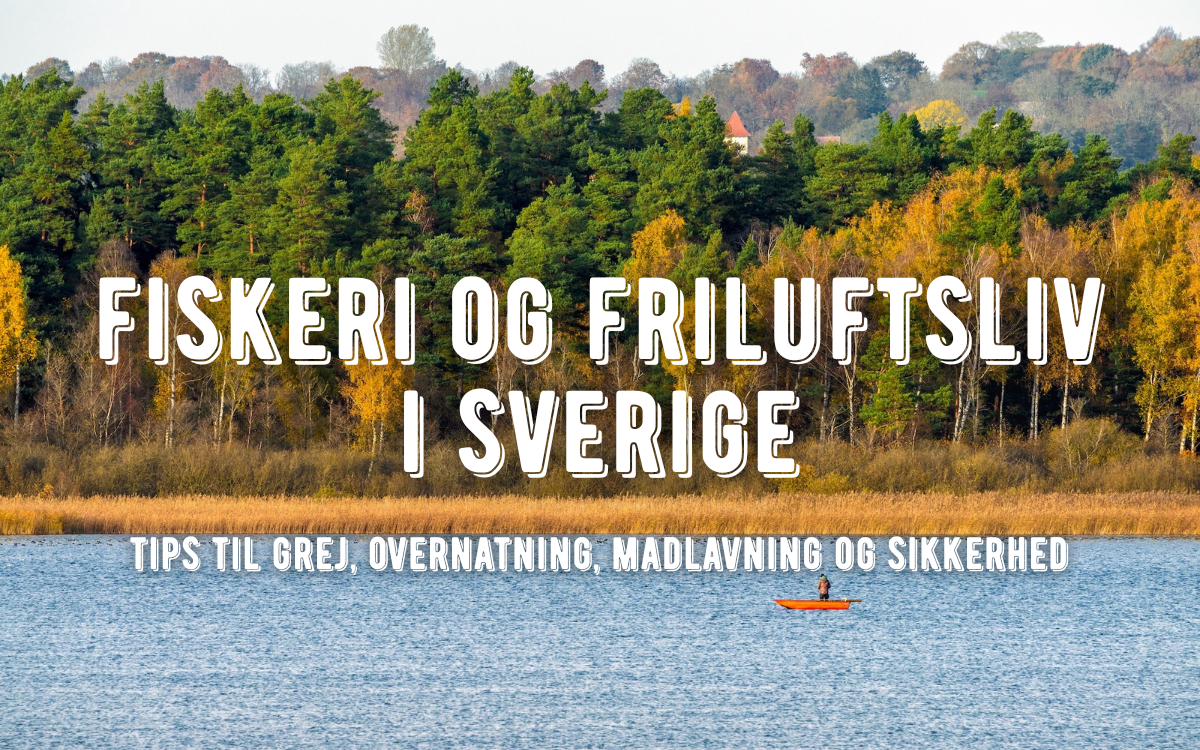
Outdoor life and recreational fishing - Your guide to a successful fishing trip in Sweden.
If you have never tried fishing and outdoor life in Sweden before, it is something we really recommend.
The Swedish wilderness invites you to find your inner bushcrafter - but if you are not quite that hardcore, less can also do.
Sweden offers wonderfully beautiful, raw, challenging, and magnificent nature that can provide experiences you will remember for a very long time. It is hard to get tired of the undisturbed, the quiet calm, the overwhelming landscape with vast cliffs, forests, and lakes as far as the eye can see.
In the following sections, we will give you tips on how to prepare for a fantastic fishing trip at the Swedish fishing waters.
Here you can go directly to the section you want to read about.

The Right of Public Access:
The Right of Public Access is an open invitation to freely move and roam in the Swedish wilderness, to explore, hike, and camp. You just need to take care of nature and animals, be considerate of other visitors in nature, and respect privacy.
Respect nature - Leave no trace - Avoid vulnerable areas such as newly planted forests, do not leave trash, clean up after yourself, and fully extinguish your fire.
Keep distance from private areas - avoid gardens, fenced fields, and private properties.
Camp thoughtfully - and only temporarily - short stays of 1-3 nights in the same place are generally accepted, choose a spot that does not disturb animals or other people.
Be quiet and calm - for both wildlife and other guests.
Respect wildlife - this applies to those in the water, on land, and in the air.
Outdoor life and fishing in Sweden - what should you bring?
Overnight stay and cooking
Overnight stay and cooking are essential on any outdoor trip. Once you have found a good spot to camp in the Swedish wilderness, you need to find out if it is allowed and/or appropriate to make a fire, or if you should use brought equipment such as a camping stove or wood stove. At certain times, there may be fire bans and local guidelines that must be followed.
We recommend that you bring:
Tent, tarp or hammock with mosquito net
Sleeping bag adapted to the season
Sleeping pad or inflatable mattress
Cookware: campfire equipment or stove, wood stove or burner.
Pot/pan and cutlery and utensils for cooking
Fire steel or matches/lighter and optionally fire starters
Thermos flask and water container
A good bushcraft knife and/or fish knife
Headlamp, lantern or similar
Clothing
Your clothing should naturally be adapted to the season. Remember that summer evenings and nights can be cool, and you never know if a rain shower will come. Also think about protection against mosquitoes and insects. It is practical to dress in layers so you can always remove some clothing if it gets too warm.
We recommend that you bring:
Waterproof and windproof outerwear
Warm mid-layer
Insulating long underwear - wool or similar in the cooler months
Underwear and extra socks
Hat and gloves (depending on the weather)
Good hiking shoes or boots
Sandals or light footwear for evenings at the camp
Fishing gear
Whether you are fishing by the coast or inland, it is important to have good gear with you. Different gear is needed depending on the type of fishing you do. You don’t necessarily need a lot of gear to make a fishing trip really fun and memorable.
We recommend that you bring:
Fishing rod/line and optionally leader for the type of fish you want to catch
Various hooks, spinners, wobblers, spoons, and bait suitable for your fishing
Fishing tools: fish knife, hook remover pliers, and optionally a catch net
Fishing license - read here how to buy a fishing license
Optional waders
Other:
First aid kit with plasters, disinfectant, bandages
Mosquito spray and possibly mosquito net for head/tent
Sunscreen
Maps and compass / GPS
Life jacket if you’re fishing from a boat
Water filter or other water purification
Drybags for storing clothes and gear
Plastic bags for trash and wet items
Toilet paper and hygiene products

Cook your catch - here’s how
It’s really something special to eat fish you’ve caught yourself. Not only does it taste incredibly good, but it’s also hard to beat the feeling of having done it all yourself – from water to table in this case. Remember to bring salt, pepper, spices, herbs, and side dishes from home.
Here is a short guide that might help you if you haven’t tried preparing and cooking your catch before:
First and foremost, the fish needs to be prepared.
How to clean the fish
1. Rinse the fish
Start by removing dirt and slime on the outside with cold water. This makes the rest of the work easier. If the fish is very slimy, you can scrape it off with a knife.
2. Remove the scales
If the fish has scales (like perch), you can scrape them off by running the knife from tail to head with light pressure – preferably do this in water so the scales don’t fly everywhere. If you caught a fish with very small scales, like trout, you don’t need to remove the scales.
3. Make a cut in the belly
Lay the fish on its side. Insert the knife into the fish’s anus (located near the tail) and carefully cut up towards the head — not too deep, so you don’t puncture the innards.
4. Remove the innards
Open the fish and carefully remove the innards with your fingers or a knife. Be careful with the gallbladder (a small green sac) — if it bursts, it can give the meat a bitter taste.
If you accidentally hit it, rinse quickly and thoroughly with water.
5. Clean the abdominal cavity
Scrape away any blood and membranes (there is often a dark bloodline along the spine). Use a spoon or knife, and rinse with cold water afterwards.
6. Cut off fins and head
You can choose to leave the head on, for example if you want to bake the fish whole, but it looks more appetizing to remove it.
7. Rinse again
Rinse the fish inside and out with cold water. Pat it dry with paper or a clean cloth.
Depending on how the fish is to be prepared, you can fillet the fish, where the meat is cut free from the bones. Perch, pike-perch, salmonids, and flatfish fillets taste really delicious! Pike can also be filleted, but it requires a bit of patience because the bone structure is different. But it is not necessary to fillet the fish - once cooked, you can carefully pull the meat away from the fish’s bones.


In many places in the Swedish nature, it is allowed to light a campfire, and there is hardly anything cozier than sitting around the flames after a long day outdoors. But always be aware that there may be temporary or local restrictions. It is important to check the current rules for the area you are in.
You can also bring a camping stove or a wood stove, both of which are smart and efficient when you need to cook outdoors.
A camping stove works well when you quickly need to heat water for coffee or when you need to cook without having to find firewood and wait for embers, while a wood stove gives the same atmosphere as a campfire, just on a smaller scale and with less risk. Both solutions are easy to pack and take up minimal space in the backpack.

Fish over campfire:
If you cook your fish over a campfire, it can be done in several ways. You can wrap the fish in aluminum foil with a little lemon, dill, and onion - or whatever you prefer - and cook the package with fish in the embers or for a few minutes. You can also use a campfire grill, rack, or pan, where you cook the fish a few minutes on each side over the hot embers.
Read here how to make authentic wilderness food - fish over campfire.
Fish on camping stove:
The camping stove gives good control over the heat, and you can fry the fish or fillets on the included pan.
Fish on wood stove:
As with the campfire, you can cook the fish on a grill or pan over your wood stove.
You can also smoke your fish over a campfire, which gives a delicious flavor and longer shelf life to the fish. The internet is full of videos showing the ways you can smoke fish over a campfire - it’s not that difficult and definitely worth trying.
Outdoor activities in Sweden - what should you be aware of?
It is a huge pleasure to venture out into the Swedish nature - but there are some things you need to be aware of and keep in mind.
Wildlife:
Nature is home to moose, deer, beavers, fish, birds, and many other wild animal species. Wild animals are shy and do not seek out humans, but you may encounter them when camping, hiking, or fishing, so remember the following:
- Keep your distance. A moose is beautiful from afar, and although moose are shy, they can potentially be dangerous, especially if they have calves nearby. Never go between a mother and her young.
- Store food securely so you don’t attract curious animals to your tent.
- Make some noise - without being loud. Yes, it sounds a bit silly. Of course, we must respect animals and other visitors in nature, but if you talk or rustle a bit on the ground, wild animals become aware of your presence and quietly move away.
Insects and small critters:
Mosquitoes and midges live their best life in the Swedish forests. And forest areas can be a true paradise for ticks, so there are some things you can do to avoid these little critters:
- Bring mosquito spray - some varieties also offer protection against ticks.
- Mosquito candles - citronella candles
- Mosquito net and long-sleeved clothes and pants, with socks pulled over the pants so ticks can’t crawl in.
- Check your body every evening for tick bites, and see here how to avoid tick bites.
Safety:
Sweden is a safe and secure country to travel in, but for safety’s sake, there are certain things you can do to optimize your safety:
- Check the weather forecast and plan a realistic route to your destination.
- Make sure to wear good and safe footwear - the rocks can be slippery near lakes and streams - take your time when moving around.
- Tell someone where you are going and when you expect to be back.
- Bring first aid, and possibly a map and compass - mobile coverage is not available everywhere in the large Swedish forests.
Then all that’s left to say is "Sharp hooks and tight lines" - Good luck and may you have a great fishing trip to Sweden.
Find more inspiration and additional tips for recreational fishing and nature experiences in Sweden in our other blog posts 👇


