
Your bushcraft guide to collecting and using birch bark in nature
Bushcraft and birch trees
This blog is a tribute to the birch tree, and more specifically its bark and the many uses of the bark when it comes to bushcraft.
Bushcraft is a set of skills and knowledge that enables you to live and thrive in nature. It is about using your surroundings to your advantage while acting responsibly and leaving nature in the same condition as you found it.
Birch is a deciduous tree species and carries the Latin name Betula. Across Asia, Europe, and North America, we find a total of 50 different birch trees, and in this blog, we are lucky that only 2 of the 50 species are found in Denmark. The two trees we have in Denmark are silver birch (Betula pendula) and downy birch (Betula pubescens). Silver birch also has the fitting name Silver Birch in English, as it almost shines silver and white on a sunny day.
In the following section, we will clarify both silver and downy birch so we know exactly which trees we are talking about.
Characteristics of the birch

You have surely seen silver birch and downy birch before, maybe the trees even stood next to each other without you noticing there was a difference. Silver birch has wart-like grayish patches in the bark and large hanging branches and leaves that give the tree, seen from outside, a rounder appearance. Downy birch, on the other hand, has more sticking-out branches and appearance, and has fuzz on the bark. In the bark of both trees, there are transverse cork pores, and the tree uses these pores to transport oxygen all the way into the inner bark, so they basically function as breathing holes for the tree.
The birch's white bark is not accidental. The bark reflects sunlight and helps protect the birch from fluctuating temperatures and the sun's light. It sounds strange, but especially in winter, the birch is at risk of getting sunburned. During the winter months, the birch is dormant, which means the tree's cells do not use energy to produce fruits, nuts, leaves, and pollen to spread. The birch can be awakened from this dormancy by the warmth of the winter sun. So when the night frost gives way to a warm winter sun, it can happen that the tree, and parts of the warmed bark, wake from dormancy and activate the cells in the cambium, the cell layer between the bark and the tree itself, but cannot deactivate and slow the process again before the night frost returns. This results in damaged bark, making the tree more susceptible to parasites and diseases such as fungal infections. The birch also uses its white bark to regulate its temperature in summer.
At the old birch trees, the lower part of the trunk is marked by large hard scaly patches of bark, and this knobby bark is difficult to use for anything useful in bushcraft.
So which part of the tree can you bushcraft with? Well, just listen...
Bushcraft and Birch Bark
Birch bark, whether from downy or warty birch, can be used for many different purposes in nature. Canoes, shelters, mugs, bowls, trays, hats, and even paper can be made from birch bark.
The bark contains a molecule called betulin, and it is precisely this molecule that makes the bark so versatile in its uses. Betulin makes the bark hydrophobic, meaning water-repellent and waterproof. So whether you have a flake from the downy birch or an A4-sized piece from the warty birch, the bark is water-repellent right down to the innermost fibers.
Betulin's water-repellent properties therefore make birch bark ideal to use as a material when constructing anything that needs to withstand nature's changing moods.
If you need a waterproof roof for your debris shelter, you can advantageously peel large sheets of birch bark off the trees and layer them.
With all the uses I just mentioned, there is a big BUT! Here in Denmark, where many forests are protected and there is already a lack of respect for nature, especially at shelter sites. So as a camper and bushcraft enthusiast, I absolutely do not recommend going around peeling large or small pieces of birch bark off the trees. As mentioned, this can open up the tree and make it susceptible to fungal infections and parasites, and in the worst case, kill the tree.
How to harvest birch bark responsibly

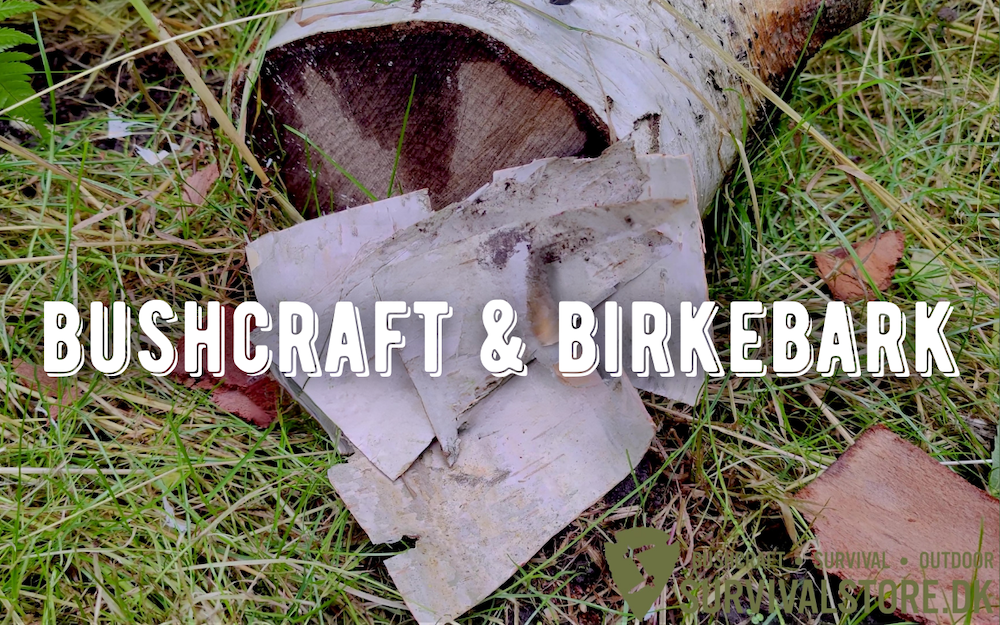
What we can do to get birch bark, however, is to explore the forest floor and find old felled or fallen trees and harvest birch bark from them. Birch bark does not decay as easily as the tree itself, and the bark can easily remain as a shell long after the tree's interior has rotted away.
The warty and downy birch are also good at making room for new and fresh bark as they grow, which means they push off some layers of the old bark that can be peeled off without damaging the new bark and the wood beneath it. Especially the downy birch has very fine bark attached, often fluttering in the wind, and if you pick all these downy flakes, you have a good pile for kindling your fire.
The outermost branches of the warty birch and downy birch, which are black and almost dark purple, are also great for your kindling as they are small, fall off in bundles/clusters, and dry quickly over the birch bark flames. The branches can ignite quickly and help build your fire. These clusters of branches often fall off and get caught by other branches or bushes, so they lie high and dry, ready to be used for the fire. However, they must fall off by themselves, as fresh birch branches do not burn efficiently and will most likely consume too much of your flames' energy and smother your fire.
Birch, bushcraft, and fire
Besides birch’s betulin molecules making it waterproof, betulin is also the reason birch bark is an effective kindling material. Because of the betulin in birch bark, you can confidently soak your birch bark in a stream, shake off the water, and ignite it immediately without problems. However, it is easiest to ignite if you process it a little bit.
Like all kindling materials, it needs to be processed, twisted, beaten, torn, and shredded so the fibers come out and are receptive to your firesteel, lighter, ember from a bow drill, or whatever your preferred fire-starting tool is. So scrape the flat surface of the birch bark with a knife or stone, gather plenty of dust and bark fibers, and then ignite your birch bark. The oil/betulin in the bark burns quickly, efficiently, and produces black smoke.
Guide to starting a fire with firesteel and birch bark
When it comes to bushcraft and fire in nature, the combination of firesteel (also called a ferrocerium rod) and birch bark is one of the most effective methods. Birch bark is full of natural oils, especially betulin, which makes it highly flammable – even when wet. This makes the bark ideal as kindling, and when you combine it with sparks from a good firesteel, you have a method that works in almost all weather conditions.
Here’s how:
Find a piece of dry birch bark and scrape it with the back of a knife to make fine, fluffy fibers.
Place the birch fibers in a small pile where the sparks can land.
Use your firesteel to make sparks – hold the steel steady and pull the knife or striker downward in a quick motion.
When the fibers catch the spark, gently blow on the flame and add small twigs and branches.
It takes a bit of practice, but once the technique is mastered, it is a reliable way to start a fire – and a fantastic skill to master as an outdoor or bushcraft enthusiast.


Compared to birch wood, it is very good for fires, both for heat and cooking. It can be a bit difficult to split due to its structure and knots, so your split logs may not be uniform in size and shape. But it does not emit smoke or soot that can affect the taste of food, unlike the resin from spruce or pine can.
Birch wood has a medium-high calorific value, which means it provides good fire and relatively quick and long-lasting embers for food that doesn't require direct flames. So it is harder to split than spruce, but definitely has a higher calorific value. However, birch wood is not as efficient in calorific value as beech, ash, and oak, which are harder wood types than birch. With all these properties, you can build a highly effective fire using only birch wood. The bark, branches, and birch wood together make an effective and useful fire in every respect.
All in all, the downy birch and silver birch are both tree species with many possibilities when it comes to bushcraft, both as building and kindling material.

The birch tree is one of the most versatile trees in Danish nature and a true friend for bushcrafters. Almost all parts of the birch tree can be used. The bark is not only great for kindling.
Thick pieces of bark can be bent and shaped into bowls, cups, or even baskets. The dense bark can also hold liquid, making it ideal for containers.
Historically, birch bark has been used as a waterproof layer under turf on the roofs of houses in the Nordic countries. So if you want waterproof covering for your shelter, birch bark can be a good solution for this.
We must also acknowledge the medicinal properties that birch “possesses.” Possesses is in quotation marks because none of the conditions, such as kidney stones, arthritis, and urinary tract infections, that birch sap, powder, or bark are said to help with are supported by significant and conclusive scientific data. But it doesn’t hurt to tap some of the sweet birch sap from the tree and drink it. In early spring, just before the leaves bud, the sap rises in the birch tree. This sap can be tapped and used as a healthy drink rich in minerals.
How to tap sap: Drill a small, angled hole in the trunk, about 1 cm in diameter and 10 cm deep, close to the ground. Insert a tube or twig into the hole and direct the sap into a bottle. Remember that the sap is 99% water, so it’s a mild, slightly sweet drink.
Make birch syrup: You can boil down birch sap to make a concentrated syrup, but be patient, as it takes a large amount of sap to make even a small amount of syrup.
Remember to close the hole with a branch when you’re done so the tree heals quickly.
The birch wood itself also has many uses. Birch wood is easy to work with, making it popular for carving items like spoons, cups, kuksas, and kitchen utensils.
As fuel, birch wood (as mentioned earlier) burns well and gives off a pleasant, sweet scent. It’s an excellent choice for campfires and provides good, long-lasting heat.
The resin that can be extracted from birch bark can be used as an adhesive and sealant. You can heat the birch bark to extract tar, which can seal containers or be used as a primitive glue.
If you’d rather see how to do it, you can watch the video below 👇