
A guide to foraging wild ingredients in May
May is the month when nature truly bursts into green. It’s the peak of spring, and the landscape is full of fresh, wild ingredients. While March and April bring the first tender shoots, May marks the real start of the high season – with dense growth, more species, and plenty of edible opportunities. The forest floor is covered with fresh shoots, and meadows and roadsides abound with plants. There is hardly any place in the landscape where you can’t find something to forage.
The season’s new plants are starting to appear – such as wild chervil, angelica, beech, and nettle – but many of the flavorful plants from March and April are still in season. Wood sorrel, nettle, wild garlic, plantain, and garlic mustard are still delicious and can be foraged with good taste and conscience.
Whether you are an experienced forager or a beginner, May is a fantastic month to head out into nature. For those of us who love outdoor life and adventures, it’s the perfect time to pack your backpack, tuck a carving knife in your belt, and explore nature’s own pantry.
Here is a guide to wild plants you can forage in May – perfect for those who love nature, outdoor life, and self-sufficiency.
1. Wild chervil (Anthriscus sylvestris) – The mild herb of the ditch edge
Wild chervil is one of the most common and striking wild herbs in May. It covers ditch edges and forest borders with its light, feather-shaped leaves and white flower umbels. The plant has a mild, fresh flavor with a hint of parsley and anise – making it a perfect herb for the wild spring kitchen.

Where is it found? Wild chervil is very common and grows along ditches, paths, forest edges, fields, and meadows. It thrives in nutrient-rich soil and is found throughout the country. It blooms from April to June and is especially widespread in May, often forming large, swaying white carpets along roadsides.
How do you recognize it? The plant has finely divided, feathery leaves that resemble a cross between carrot tops and parsley. It grows up to one meter tall and produces small, white flowers gathered in flat umbels. The stem is hollow, often slightly grooved, and can have a faint reddish tint at the base. The leaves have a mild, green, spicy scent – somewhat like parsley with a hint of anise.
How to use it: The tender leaves and flower umbels are edible and can be used as herbs in salads, herb butter, dressings, pesto, or as garnish. The mild flavor makes it suitable for dishes where you want a green and slightly sweet note – without it becoming too strong. It can also be used in herbal tea or dried for later use. The young leaves taste best while the plant is still standing before or in early flowering.
Foraging tip:
Important when foraging umbellifer plants!
Wild chervil belongs to the umbellifer family, which includes many edible species, but there are also very poisonous species like hemlock and giant hogweed. Confusing them can be dangerous.
➡️ Only gather if you are completely sure of the species identification.
➡️ Use a good book, app, or foraging guide for help.
➡️ If in doubt – leave the plant!

2. Beech (Fagus sylvatica) – Lovely flavor and easy to find
Beech is one of Denmark’s most widespread trees – and in May, the tender, light green leaves can be used as a mild, tangy, and crisp food. The young leaves are tender and delicate, and although they are only suitable for gathering for a short period, they are a spring favorite in wild salads, snacks, and schnapps. Later in the year, you can also gather beechnuts – the tree’s nuts – which are a hidden delicacy from the forest floor.

Where is it found? Beech is very common in Denmark and covers large parts of the country’s deciduous forests. You can find it in woods, parks, along paths, and in shelterbelts. In May, the leaves sprout and are briefly silky soft, light green, and suitable for gathering. After a few weeks, they become tough and bitter, so timing is important.
How to recognize it? Beech leaves are easy to identify: they are oval with wavy edges and fine hairs along the margin, especially when newly sprouted. They have a characteristic light green color and are very thin and soft in the first days after sprouting. The tree has smooth, gray bark and often grows in dense, shady forests.
How to use it: The tender beech leaves can be eaten fresh as snacks directly from the tree or used as a tangy and crisp ingredient in salads, sandwiches, or herb butter. They can also be used in homemade schnapps, where they add a beautiful color and mild flavor. Later in the year, you can gather beechnuts – the tree’s small nuts – which can be roasted and eaten but should be enjoyed in small amounts due to the presence of mildly toxic substances (including fagin).
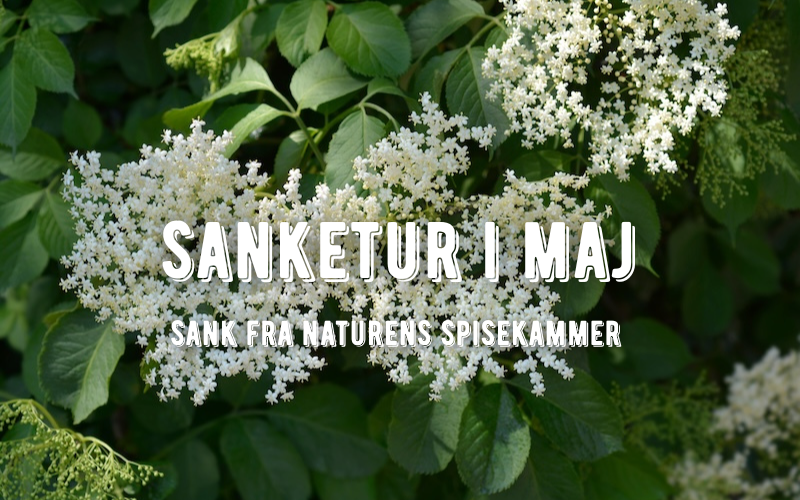
3. Elderflower (Sambucus nigra) – Fragrant and flavorful flowers
Elderflower is one of the most beloved wild edible flowers in Denmark. The large, flat flower clusters smell sweet and aromatic and mark the start of summer for many. In May and June, you can find them in full bloom along paths, fences, and forest edges – ready to be transformed into juice, syrup, vinegar, pancakes, and much more.

Where is it found? Elder grows all over the country – especially in forest edges, shelterbelts, gardens, and open areas. It thrives in sun and nutrient-rich soil and is easy to recognize as a large shrub or small tree. Flowering begins in May in the warmer regions and typically continues into June.
How do you recognize it? Elderflower forms large, flat clusters of small, white flowers with a strong, sweet scent. The leaves are compound with 5–7 elongated leaflets with serrated edges. The bark on older branches is gray-brown and furrowed. The flower clusters sit at the top of the branches and are easy to pick – but harvest only in dry weather and full sun, where they smell the most and contain the most aromatic oils.
How to use it: Elderflower is incredibly versatile in the kitchen. Use the flower clusters for juice, syrup, vinegar, schnapps, tea, ice cream, sorbet, or as crispy flowers in pancake batter. They can also be dried and stored for winter teas and spice blends. Use only fully open flowers, and avoid leaves, stems, and green parts, as they may contain bitter and slightly toxic substances (sambunigrin).
4. Forget-me-not (Myosotis spp.) – Edible flower from the roadside
Forget-me-not is one of spring’s most beloved wildflowers with its small, bright blue flowers and yellow eye. Besides being beautiful and symbolic, it is also edible – and can be used as edible decoration in the wild outdoor kitchen. The flowers have a mild flavor and are especially suitable for salads, desserts, and drinks.

Where is it found? Forget-me-not grows in meadows, ditches, moist clearings, and by streams. It thrives in slightly damp soil and is found in many places in Denmark – both as a wild plant and as a naturalized garden plant. You typically find it in bloom from April to June.
How do you recognize it? The plant is low and easily recognizable by its small, sky-blue flowers with a yellow center and five petals. The leaves are elongated and slightly hairy. The flowers grow clustered in small curled tops, and the whole plant has a soft, somewhat fuzzy surface. It often grows in carpets, especially in moist areas.
How to use it: It is the flowers you use – they have a mild, almost neutral taste and work best as edible decoration. They can be used fresh in salads, sprinkled on desserts, cakes, or served on open sandwiches. They also work well in ice cubes, tea blends, or as decoration in wild lemonade or gin & tonic when you are out in nature.
Foraging tip:
There are many species of forget-me-not, and they are generally considered safe to eat in small amounts. But they are mainly used as decoration – not as a main ingredient.
5. Dandelion flower (Taraxacum officinale) – The whole plant can be foraged
The dandelion is one of the most recognizable wild plants – and not just a weed! The bright yellow flowers are edible and have a mild, slightly bitter taste suitable for both sweet and savory dishes. In May, fields, gardens, and ditches bloom all over the country, and the flower heads are ready to pick for your trip – as decoration, ingredient, or experiment in your wild outdoor kitchen.

Where is it found? Dandelions grow everywhere – in lawns, ditches, meadows, fields, paths, and open areas. They require no special soil and thrive in both sun and partial shade. May is peak blooming season, and the flowers can be foraged in large quantities almost anywhere.
How to recognize it? The flower is easy to identify: a round, dense, yellow flower cluster on a hollow, juicy stem. When you break the stem, a white milky sap oozes out (hence the name). The leaves grow in a rosette and have serrated edges. There are several species of dandelion, but they are all edible and used in the same way.
How to use it: It is the flower heads you use – preferably fresh and newly bloomed. You can sprinkle the petals in salads, use them as decoration, or mix them into herb butter. Whole heads can be breaded and fried, used for schnapps, or transformed into dandelion syrup – a kind of “wild honey.” The flowers can also be dried for tea. Use them quickly after picking, as they close and wilt fast.
Foraging tip:
Avoid picking flowers growing in polluted soil – for example, near roads, fields, or sprayed areas. Choose fresh flowers from clean, natural locations.
6. Sea purslane (Honckenya peploides) – Wild sea green with a mild cucumber flavor
Sea purslane is a robust and juicy plant that grows right out in the salty coastal environment where few other plants thrive. The fleshy, light green leaves taste mild and slightly salty and can be foraged as crisp greens for both camp kitchens and outdoor salads. It is easy to recognize and grows in large quantities.

Where to find it? Sea purslane is found along the entire Danish coast – especially on sandy beaches, dunes, and beach ridges. It grows right down by the water where the soil is sandy. It can be foraged most of the spring and summer, but the shoots are best in May and June while they are still fresh and crisp.
How to recognize it? The plant grows in dense, low mats with small, thick, shiny light green leaves that almost look like small succulents. It spreads low over the sand and has stiff, fleshy shoots. When flowering, it produces small, white-green star-shaped flowers. It’s easy to recognize, and there is no risk of confusion along Danish beaches.
How to use it: The fresh shoots and leaves can be eaten raw and have a mild, slightly salty taste and a crisp texture – perfect as the beach’s answer to lamb’s lettuce. Use them in salads, on open sandwiches, as a green garnish, or in sandwiches on the go. They can also be quickly fried in a pan over a campfire or tossed in oil and lemon as a side dish for fish. They are also suitable for fermenting or as “beach pesto.”
The beach is not just a place for sunbathing and swimming – it’s also an exciting place to forage. Besides sea purslane, there are several tasty wild plants you can forage on your next trip along the coast. Two of the most common and useful species are sea kale and sea beet, both of which have a firm place in the Nordic beach kitchen.
These plants are easy to recognize, grow in large numbers, and can be used both in the wild outdoor kitchen and at home in your pots. Foraging at the beach offers a special experience – you get fresh air, sea views, and delicious ingredients to take home in your bag. Want to learn more about foraging sea kale and sea beet? Then read the foraging blog from March and the Trangia recipe with wild beach plants, where you’ll find inspiration to use your beach finds directly on your trip.


Whether you are new to foraging or already familiar with common forest herbs, it's a great idea to take a trip to the beach and expand your foraging palette with the salt-tolerant plants from the water's edge.
🌿 Ready for your next foraging trip?
May is one of the best months of the year to forage – nature is bursting with edible shoots, flowers, and wild herbs, and you don’t have to go far to fill your basket. Whether you go on a planned foraging trip or just pick a little along your hike, there’s plenty to find and taste.
Remember to forage responsibly: only take what you need, and leave the rest for nature, animals, and other foragers. Use reliable sources for species identification, and don’t take anything home if you’re unsure.
With a little knowledge and the right gear in your backpack, foraging is a great way to combine outdoor life, cooking, and nature experiences. Have a great time out in the green – and enjoy your wild finds!
Foraging tips for your next foraging trip
🌿 Forage the young shoots first
When you forage wild plants, the tender shoots and fresh leaves often have the most flavor and best texture. They’re perfect to forage early in the season.
🚫 Forage only in clean areas
Avoid foraging near busy roads, fields with pesticides, or industrial areas. A good foraging trip requires a clean and healthy foraging area.
🔍 Learn a few plants to forage at a time
If you’re new to foraging, start with 3-5 safe species. It makes it easier to remember and recognize them on your next foraging trip.
👣 Watch where you step
Many plants you can forage grow close to the ground. Walk carefully and watch your step – the best finds are often the ones you almost overlook.
✂ Use a knife or scissors to forage gently
When you forage shoots, flowers, or leaves, a clean cut is best – it protects the plant and ensures you can forage the same spot again later.
📚 Combine app and book when foraging
A good foraging app is useful but should always be supplemented with a foraging book. You need to be able to identify what you want to forage with full certainty.
🧤 Bring gloves on your foraging trip
Some plants you can forage grow in hard soil or among nettles. A pair of gloves makes foraging easier and more comfortable.
🧂 Taste cautiously when foraging something new
When you forage a new species, start with a small taste. It’s a good rule of thumb in all foraging, as some plants can have a strong flavor.
🌱 Sort what you forage along the way
Divide flowers, herbs, and roots into bags or containers. This keeps your foraged finds fresh and makes it easy to continue working with them at home.